SEO vs GEO: Key Differences and Which One Your Business Needs
Introduction
The way people search for information online is changing. For years, businesses have relied on Search Engine Optimization (SEO) to improve their website rankings on Google and attract organic traffic. Today, AI-powered tools such as ChatGPT, Google AI Overviews, and other generative AI search experiences are changing how users discover information, compare services, and make purchasing decisions.
This shift has introduced a new term: Generative Engine Optimization (GEO).
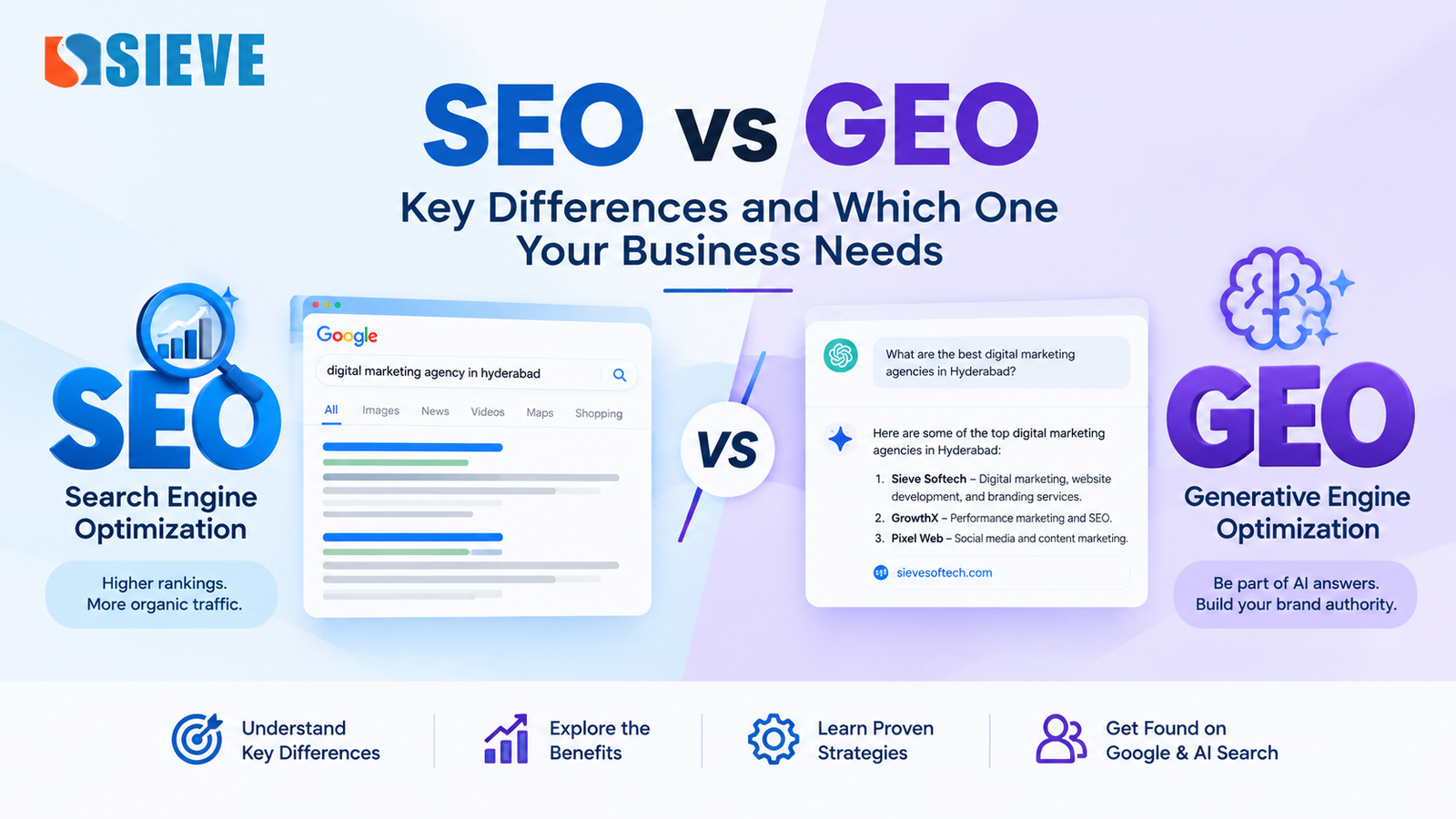
While SEO focuses on helping web pages appear prominently in traditional search engine results, GEO focuses on improving the chances that a brand, website, or its content will be referenced in AI-generated answers.
But does GEO replace SEO? Which strategy should your business invest in? And how can you prepare your website for both traditional and AI-powered search?
In this guide, we will explain the differences between SEO and GEO, their benefits, practical optimization strategies, and how businesses can combine both approaches to improve online visibility.
What Is SEO (Search Engine Optimization)?
Search Engine Optimization, commonly known as SEO, is the process of improving a website so that it can rank higher in organic search results on search engines such as Google and Bing.
The main goal of SEO is to help search engines understand your content and connect it with people searching for relevant products, services, or information.
For example, when someone searches for “website development company in Hyderabad,” a well-optimized website may appear among the organic search results if its content, relevance, authority, and technical performance meet the search engine’s requirements.
Key Components of SEO
1. Keyword Research
Keyword research identifies the words and phrases your potential customers use when searching online. Businesses can use these insights to create content that addresses relevant search intent.
Examples include:
- Digital marketing agency in Hyderabad
- Website development services
- SEO services for small businesses
- Custom software development company
2. On-Page SEO
On-page SEO involves optimizing individual web pages through relevant titles, meta descriptions, headings, content, internal links, image alt text, and appropriate keyword usage.
3. Technical SEO
Technical SEO helps search engines discover, crawl, and understand your website. Important areas include page speed, mobile usability, site architecture, canonical URLs, XML sitemaps, and indexability.
4. Off-Page SEO
Off-page SEO includes activities that strengthen a website’s reputation and authority, such as earning relevant backlinks, building brand awareness, and obtaining credible mentions from other websites.
5. Content Optimization
Useful, original, well-structured content helps answer customer questions and supports visibility for relevant search queries.
Benefits of SEO
SEO can help businesses achieve several long-term benefits:
- Increase organic website traffic.
- Improve visibility for relevant search terms.
- Build brand credibility and trust.
- Attract users who are actively researching solutions.
- Generate qualified leads over time.
- Support sustainable digital marketing growth.
SEO remains an important part of digital marketing because traditional search engines continue to help people discover websites, compare providers, and research buying decisions.
What Is GEO (Generative Engine Optimization)?
Generative Engine Optimization, or GEO, is the practice of improving content and brand visibility in AI-generated search answers.
Traditional search engines generally present a list of links. Generative AI experiences can instead produce a summarized response that combines information from multiple sources and may cite or link to supporting pages.
For example, a user might ask an AI search tool, “What should I look for when choosing a digital marketing agency in Hyderabad?”
The tool may generate an answer discussing experience, services, case studies, reporting, and pricing. Depending on the system and query, it may also reference relevant websites or brands.
GEO aims to make your content useful, clear, credible, and accessible enough to be considered as a source for these AI-generated responses.
It is important to understand that GEO does not guarantee a mention in AI answers. AI systems select and present information in different ways, and their results can change between queries and platforms.
Key Components of GEO
1. Clear and Direct Answers
Structure content to answer specific questions clearly. Short explanations followed by supporting details can help both readers and AI systems understand the main point of a page.
2. Reliable and Original Information
Publish accurate information supported by trustworthy sources, expert knowledge, relevant examples, and first-hand experience where available.
3. Structured Content
Use descriptive headings, meaningful lists, comparison tables, and concise definitions to make complex information easier to understand.
4. Brand Authority
Build a consistent, credible online presence through useful content, relevant industry publications, legitimate brand mentions, customer reviews, and expert contributions.
5. Technical Accessibility
Make sure important pages can be crawled and accessed by relevant search systems. Keep your website structure clear, avoid unnecessary technical barriers, and use appropriate structured data where applicable.
6. Consistent Brand Information
Ensure that your company’s services, contact details, expertise, and business descriptions are accurate and consistent across your website and other trusted online profiles.
Benefits of GEO
GEO can help businesses work toward the following outcomes:
- Improve opportunities to be referenced in AI-generated answers.
- Increase brand awareness during AI-assisted research.
- Make useful content easier to understand and reference.
- Build credibility across traditional and AI-powered discovery channels.
- Reach potential customers who research solutions through conversational questions.
GEO is an emerging optimization approach. Its measurement methods and best practices continue to develop, so businesses should evaluate results rather than assume that a particular tactic guarantees AI visibility.
SEO vs GEO: Key Differences
Although SEO and GEO have different areas of focus, they share an important objective: helping people discover useful information and credible businesses.
Here are the main differences.
| Factor | SEO | GEO |
|---|---|---|
| Full form | Search Engine Optimization | Generative Engine Optimization |
| Primary focus | Organic visibility in search results | Visibility in AI-generated answers |
| Typical platforms | Google Search, Bing | ChatGPT search, Google AI experiences, Perplexity and other AI answer systems |
| Main objective | Improve rankings and attract relevant organic traffic | Increase opportunities for content and brands to be referenced in AI answers |
| Content approach | Match search intent and provide useful, optimized content | Provide clear, credible, well-supported answers that AI systems can interpret |
| Important signals | Relevance, content quality, links, technical accessibility, and other ranking signals | Content quality, source credibility, relevance, accessibility, and system-specific selection processes |
| Common measurements | Rankings, impressions, clicks, organic sessions, conversions | AI citations or mentions, referral visits, brand visibility, and assisted conversions where measurable |
| User experience | Users often browse and compare search results | Users may receive a synthesized answer before visiting a website |
| Expected results | Depends on competition, search demand, and implementation | Depends on the AI platform, query, source selection, and implementation |
| Best approach | Build sustainable organic search visibility | Complement SEO by improving visibility in AI-driven discovery |
The main distinction is the type of visibility each strategy emphasizes. SEO focuses on organic search performance, while GEO focuses on being represented in AI-generated answers.
Neither approach guarantees rankings, citations, or conversions.
Does GEO Replace SEO?
No. GEO should generally complement SEO rather than replace it.
Search engines and AI tools overlap in their use of online information, but they do not all retrieve, rank, or present information in the same way. Some AI experiences include links to supporting websites, while others may provide limited source information or different types of responses.
A business that abandons SEO to focus only on GEO may miss valuable opportunities to attract users through traditional search.
Similarly, a business that focuses exclusively on conventional rankings may overlook the growing role of AI-assisted research and discovery.
A balanced strategy should therefore include:
- Strong technical SEO and crawlability.
- Helpful content that answers real customer questions.
- Credible sources and demonstrable expertise.
- Clear company and service information.
- Useful internal links and relevant external references.
- Tracking of both search performance and AI-related visibility where data is available.
The goal is not to choose between SEO and GEO. It is to make your website useful and discoverable across the channels your audience uses.
How to Optimize Your Website for Both SEO and GEO
Businesses do not necessarily need separate content strategies for SEO and GEO. Many foundational practices support both.
1. Understand Your Audience’s Search Intent
Start by identifying the questions your potential customers ask before choosing a product or service.
For a software development company, these questions might include:
- How much does custom software development cost?
- How do I choose a website development company?
- What are the benefits of business process automation?
- Should I choose custom software or ready-made software?
Use these questions to create focused, informative pages that address genuine customer needs.
2. Create Helpful, Original Content
Avoid publishing articles that repeat the same general information available everywhere else. Add practical examples, expert explanations, relevant data, and useful recommendations.
For instance, a blog about choosing a digital marketing agency could include a vendor evaluation checklist, questions to ask during a consultation, and common warning signs to consider.
Original value makes the content more useful to readers and gives your business a stronger reason to be referenced.
3. Use Descriptive Headings and Clear Answers
Organize your articles into logical sections. Answer the main question early, then provide the supporting explanation.
For example:
Question: What is the difference between SEO and GEO?
SEO improves a website’s visibility in traditional organic search results. GEO aims to improve the chances of a website or brand being referenced in AI-generated answers.
A clear definition like this can help readers understand the topic quickly. Expand it with examples, evidence, and practical guidance.
4. Strengthen Your Website’s Technical Foundation
Ensure that your important pages are accessible to search engines and relevant AI systems.
Review your website for:
- Crawlability and indexability issues.
- Mobile responsiveness.
- Broken links and redirect errors.
- Slow-loading pages.
- Duplicate or confusing URLs.
- Missing or incorrect canonical tags.
- Appropriate structured data.
Structured data can help search engines interpret page information, but it does not guarantee a rich result or an AI citation.
5. Demonstrate Experience and Trustworthiness
Provide accurate business information, clear author details where appropriate, transparent contact information, and evidence supporting important claims.
Publish genuine case studies, customer success stories, and examples of your work when you have permission to share them.
Do not invent testimonials, statistics, credentials, or client results. Credibility depends on information that users can trust.
6. Build Relevant Brand Mentions and Links
Earn backlinks and mentions through useful resources, industry partnerships, expert contributions, and original research.
Avoid buying large numbers of low-quality links or creating artificial mentions solely to influence AI systems. Focus on earning recognition from relevant, reputable sources.
7. Measure Results Regularly
Use Google Search Console to monitor impressions, clicks, search queries, and organic performance. Use website analytics to track sessions, enquiries, and conversions.
Where available, monitor AI referral traffic, citations, brand mentions, and qualified leads from AI-assisted discovery.
Because AI responses can vary by platform and query, use repeatable tracking methods and treat individual observations cautiously.
Which Strategy Does Your Business Need?
The right balance depends on your business model, audience, goals, and current online visibility.
Small Businesses and Local Service Providers
For local businesses, SEO should usually remain a priority. Optimize service pages, location information, Google Business Profile details, customer reviews, and relevant local content.
GEO can complement these efforts by making business information and service explanations easier to discover through AI-powered research.
E-Commerce Businesses
E-commerce companies should focus on product-page optimization, category pages, technical SEO, product information, and relevant customer questions.
GEO can complement this strategy through detailed buying guides, product comparisons, accurate specifications, and useful explanations that help customers evaluate their options.
B2B and Software Companies
B2B companies often have longer buying cycles and customers who compare multiple vendors before making decisions.
SEO can attract people searching for solutions, while GEO-focused content can help the business present clear answers during AI-assisted research.
Comparison pages, implementation guides, industry-specific articles, case studies, and transparent service information can support both approaches.
Startups and New Businesses
New businesses should establish a strong website and SEO foundation before investing heavily in advanced optimization experiments.
Create useful pages around core services, target realistic search terms, and publish content that demonstrates your expertise. Then track AI visibility as an additional discovery channel.
Common SEO and GEO Mistakes to Avoid
Businesses can waste time and resources when they approach optimization with unrealistic expectations.
Avoid these common mistakes:
Keyword stuffing: Repeating the same phrase unnaturally does not create a good user experience.
Publishing low-value AI-generated articles: Using AI tools is not inherently a problem, but publishing unverified, repetitive content without meaningful value can weaken quality.
Ignoring technical SEO: Helpful content cannot perform well if important pages are inaccessible or have serious technical problems.
Treating GEO as a guaranteed shortcut: No legitimate optimization provider can guarantee that an AI platform will mention a specific brand in every relevant answer.
Using fake authority signals: Fabricated reviews, misleading credentials, and artificial backlinks can undermine trust.
Measuring only rankings: Rankings matter, but businesses should also evaluate traffic quality, leads, enquiries, conversions, and brand visibility.
Neglecting the customer experience: Visibility is only part of the goal. Your website must also explain your services clearly and make it easy for visitors to take the next step.
The Future of SEO and GEO
Search is becoming more varied, with traditional results, AI-generated summaries, conversational search, and other discovery experiences serving different user needs.
This does not mean traditional SEO is disappearing. Instead, businesses have more opportunities to help potential customers find and evaluate information across different channels.
The strongest long-term approach is to create useful content, maintain a technically sound website, demonstrate genuine expertise, and communicate your business’s value clearly.
As AI search products evolve, companies should monitor changes in their target markets and adjust their strategies based on measurable results rather than short-term trends.
For businesses investing in digital growth, combining SEO fundamentals with thoughtful GEO practices can help create a more resilient online visibility strategy.
Conclusion
SEO and GEO are closely related, but they focus on different forms of online discovery. SEO helps websites compete for visibility in traditional organic search results, while GEO aims to improve the chances that useful content and credible brands will be referenced in AI-generated answers.
Neither strategy should be treated as a guaranteed source of traffic. Results depend on content quality, competition, technical accessibility, user needs, and the behavior of individual search systems.
For most businesses, the practical choice is to build a strong SEO foundation and extend it with GEO-focused content practices. By answering customer questions clearly, publishing original information, maintaining a trustworthy website, and tracking meaningful outcomes, your business can prepare for both traditional and AI-powered search.
Looking to improve your website’s online visibility? Sieve Softech can help your business develop a digital strategy that aligns website performance, search visibility, and business growth goals. Explore the services available on our website to identify the right next step for your business.
Frequently Asked Questions (FAQs)
1. What is the main difference between SEO and GEO?
SEO focuses on improving visibility in traditional organic search results. GEO focuses on improving the chances of content and brands being referenced in AI-generated answers.
2. Is GEO better than SEO?
Neither is universally better. SEO remains important for organic search traffic, while GEO can complement it by addressing AI-powered discovery. The right balance depends on your audience and business objectives.
3. Does GEO replace traditional SEO?
No. GEO is best treated as a complementary approach. Technical SEO, relevant content, website accessibility, and a strong user experience remain important foundations.
4. How can I optimize my website for GEO?
Create clear, accurate, original content; answer relevant customer questions; demonstrate expertise; maintain accessible web pages; and build a credible online presence. Monitor AI visibility where reliable measurement is available.
5. How long does SEO or GEO take to show results?
There is no fixed timeline. SEO improvements may take weeks or months to become measurable, depending on competition, website condition, and the work involved. GEO visibility can vary between platforms and queries, so results should be monitored over time.
6. Can small businesses benefit from GEO?
Yes. Small businesses can publish useful local guides, detailed service pages, original expert content, and clear business information. These practices can support both traditional SEO and AI-powered discovery.
7. How do I measure GEO performance?
Where data is available, monitor AI referral visits, brand mentions, citations, and leads. Test a consistent set of relevant queries across selected platforms and record the results over time, recognizing that AI answers may change.
8. Should I hire an SEO agency or a GEO specialist?
Look for a provider who understands technical SEO, content strategy, website performance, and emerging AI search experiences. Ask how the provider measures results and avoid anyone promising guaranteed rankings or AI citations.