
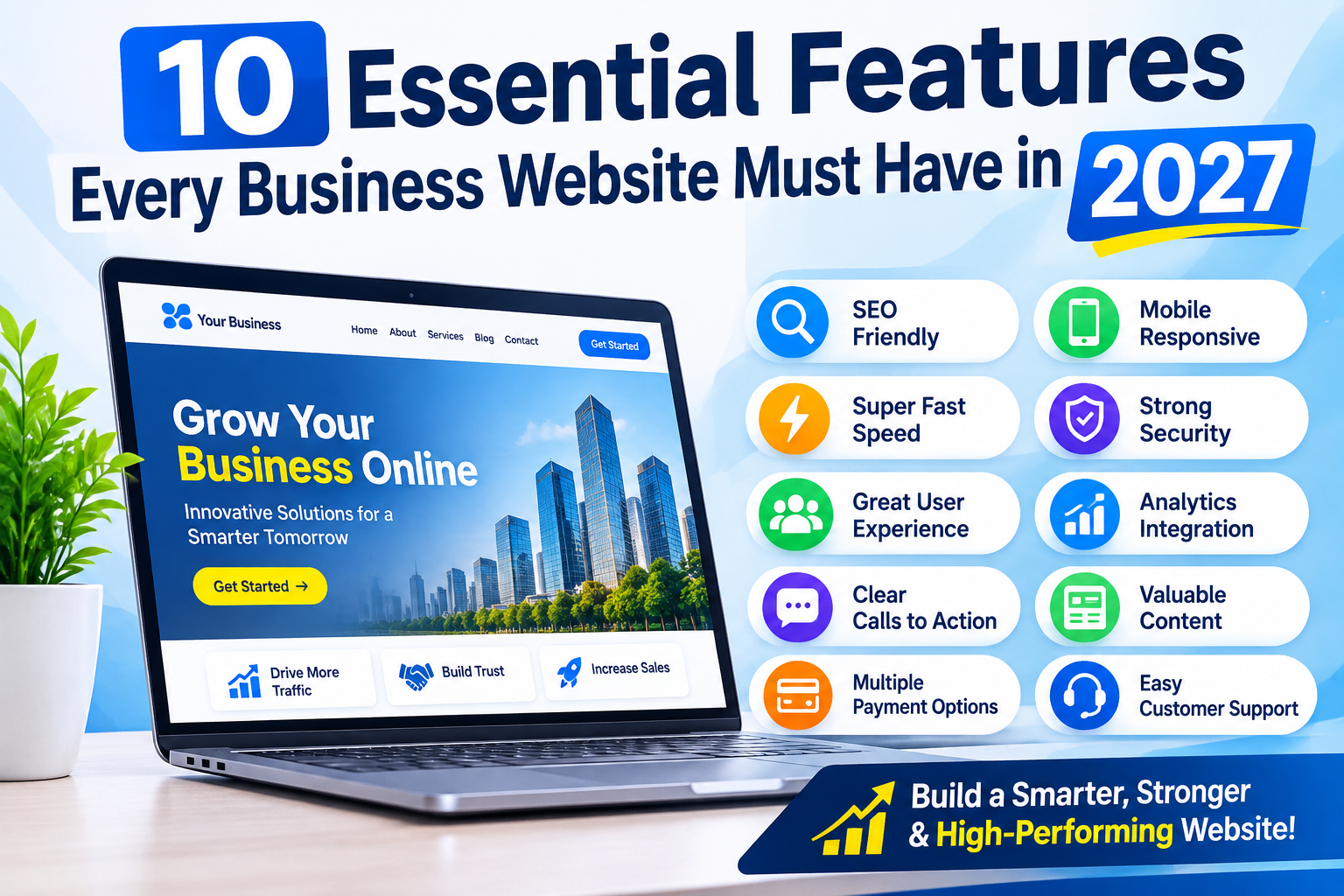
In today’s competitive digital world, having a website is no longer enough to make your business successful. Your website must be fast, secure, mobile-friendly, user-friendly, and optimized for search engines. Whether you run a startup, small business, or established company, your website plays an important role in attracting potential customers, building trust, and generating leads.
As technology and customer expectations continue to evolve, businesses need modern websites that deliver excellent user experiences. In 2027, a successful business website should combine attractive design, strong functionality, search engine optimization (SEO), and effective conversion strategies.
If you are planning to build a new website or upgrade your existing one, here are 10 essential features every business website must have in 2027.
1. Mobile-Friendly and Responsive Website Design
Most internet users access websites through smartphones and tablets. Therefore, responsive website design is one of the most important features of a modern business website.
A responsive website automatically adjusts its layout, images, text, and navigation according to different screen sizes.
Why it matters:
- Provides a consistent experience across mobile, tablet, and desktop devices.
- Improves user engagement.
- Helps support mobile SEO performance.
- Makes it easier for visitors to contact your business.
Businesses should prioritize mobile-first website development to ensure their websites work smoothly on all devices.
2. Fast Website Loading Speed
Website speed directly affects user experience and business performance. Visitors may leave a website if pages take too long to load.
A fast-loading website helps users find information quickly and encourages them to explore your services.
Important website speed optimization practices include:
- Compressing images without losing quality.
- Using optimized code and lightweight themes.
- Enabling browser caching.
- Choosing reliable web hosting.
- Reducing unnecessary scripts and plugins.
- Implementing modern image formats such as WebP.
Website performance is also important for Google’s page experience signals and Core Web Vitals.
3. Search Engine Optimization (SEO)
A professional website should be built with SEO in mind. Search engine optimization helps your business website appear in relevant Google search results and attract organic visitors.
Without proper SEO, even a beautifully designed website may struggle to reach its target audience.
Essential SEO features include:
- SEO-friendly URLs.
- Proper title tags and meta descriptions.
- Optimized heading structure (H1, H2, and H3).
- Image alt text.
- XML sitemap.
- Robots.txt configuration.
- Internal linking.
- Structured data where relevant.
- Mobile-friendly design.
Businesses should also publish useful, relevant blog content to answer customer questions and improve their online visibility.
4. Clear Navigation and User-Friendly Design
Website navigation helps visitors find the information they need without confusion. A complicated website structure can frustrate users and cause them to leave.
Your website should have a clean layout with clearly organized menus and accessible information.
Recommended navigation elements:
- Home
- About Us
- Services or Products
- Portfolio
- Blog
- Contact Us
Use clear labels, readable fonts, consistent colors, and an intuitive page structure. A simple and professional design helps visitors understand your business and explore your offerings.
5. Strong Call-to-Action (CTA) Buttons
A business website should not simply provide information. It should encourage visitors to take action.
Call-to-action buttons guide users toward the next step, such as contacting your team, requesting a quotation, booking a consultation, or purchasing a product.
Examples of effective CTAs:
- Get a Free Quote
- Contact Our Team
- Book a Consultation
- Explore Our Services
- Request a Demo
- Get Started Today
Place CTA buttons strategically on your homepage, service pages, landing pages, and contact sections.
6. Website Security and SSL Certificate
Website security is essential for protecting your business and customer information. Visitors are more likely to trust websites that use secure connections.
An SSL certificate enables HTTPS encryption and helps protect information exchanged between the website and its visitors.
Important website security features include:
- HTTPS with a valid SSL certificate.
- Regular software and plugin updates.
- Strong administrator passwords.
- Secure hosting.
- Regular website backups.
- Spam protection.
- Access controls and security monitoring.
For e-commerce websites and platforms collecting customer information, additional security measures are especially important.
7. Contact Forms and Multiple Communication Options
Making it easy for customers to contact your business is essential for generating leads.
Your website should provide multiple communication options so visitors can choose the method they prefer.
Useful contact features include:
- Simple enquiry forms.
- Click-to-call phone numbers.
- Business email addresses.
- WhatsApp chat integration.
- Google Maps location.
- Social media links.
Keep enquiry forms short and request only the information your business needs. This can make it easier for potential customers to submit enquiries.
8. High-Quality Content and Business Blog
Content helps explain your services, answer customer questions, and demonstrate your industry knowledge.
A business blog is an effective way to target relevant keywords, attract organic traffic, and build credibility.
Consider publishing content such as:
- Industry news and updates.
- Educational articles.
- Product and service guides.
- Frequently asked questions.
- Customer success stories.
- Practical tips and tutorials.
Create original, useful content that addresses your audience’s needs instead of publishing articles only to include keywords.
9. Google Analytics and Conversion Tracking
Understanding how visitors interact with your website helps you make better marketing decisions.
Analytics and conversion tracking allow businesses to measure website traffic, visitor behaviour, enquiry submissions, and marketing campaign performance.
Recommended tracking tools include:
- Google Analytics 4 (GA4).
- Google Search Console.
- Google Tag Manager.
- Google Ads conversion tracking.
- Meta Pixel, where relevant.
With accurate tracking, businesses can identify their best-performing pages, understand traffic sources, and improve their marketing campaigns.
Remember to configure consent and privacy practices appropriately when collecting visitor data.
10. Social Media Integration and Customer Reviews
Social media integration helps visitors connect with your business across different online platforms.
Your website should make it easy for customers to find your social media profiles and explore your brand’s online presence.
Useful social proof features include:
- Links to Facebook, Instagram, LinkedIn, and YouTube.
- Genuine customer testimonials.
- Verified review links.
- Client logos, with permission.
- Case studies and project portfolios.
- Customer success stories.
Displaying authentic reviews and testimonials can increase customer confidence and help potential buyers make informed decisions.
Bonus: Make Your Website Ready for Future Technology
In 2027, businesses should also consider emerging technologies and changing customer expectations.
Depending on their needs, companies can explore:
- AI-powered chatbots for customer support.
- Website personalization.
- CRM integration.
- Automated enquiry management.
- Progressive Web App (PWA) capabilities.
- Accessibility improvements.
- Advanced website performance monitoring.
Choose technologies that solve real customer problems rather than adding unnecessary features.
Why Choose Professional Website Development for Your Business?
Building a successful website requires more than attractive graphics. It involves planning, user experience design, development, SEO, security, and ongoing maintenance.
A professional website development team can help businesses create websites that align with their goals and customer expectations.
Sieve Softech helps businesses strengthen their digital presence through website development, digital marketing, SEO, and technology solutions. With a focus on performance, usability, and business growth, the right digital strategy can help your website become an effective business asset.
If you are planning to launch a new website or improve your existing online presence, investing in professional website development can be a valuable step toward long-term growth.
Conclusion
A modern business website should do more than display company information. It should attract visitors, build trust, provide a smooth browsing experience, and convert potential customers into enquiries.
The 10 essential features discussed in this article—responsive design, fast loading speed, SEO optimization, user-friendly navigation, strong CTAs, website security, contact options, quality content, analytics, and social media integration—can help create a successful business website in 2027.
Whether you are a startup or an established company, make sure your website is designed around your customers and business objectives.
Ready to build a professional business website? Contact Sieve Softech and take the next step toward growing your business online.
Frequently Asked Questions (FAQs)
1. What are the most important features of a business website in 2027?
The most important features include responsive design, fast loading speed, SEO optimization, secure browsing, easy navigation, clear CTAs, contact forms, quality content, analytics, and social media integration.
2. Why is SEO important for a business website?
SEO helps your website appear in relevant search results, attract organic traffic, improve online visibility, and reach potential customers actively searching for your products or services.
3. How much does it cost to develop a business website?
Website development costs depend on the design, number of pages, functionality, integrations, and technology used. A basic business website generally costs less than a custom website or e-commerce platform.
4. Is a mobile-friendly website necessary for businesses?
Yes. A mobile-friendly website provides a better browsing experience for smartphone users, supports mobile SEO, and makes it easier for customers to interact with your business.
5. How can I generate more leads through my business website?
Use clear call-to-action buttons, simple enquiry forms, WhatsApp integration, relevant landing pages, useful content, and conversion tracking to improve lead generation.
6. How often should a business website be updated?
Review your website regularly. Update content, security software, plugins, business information, and performance as needed. Publish fresh content when it provides genuine value to your audience.