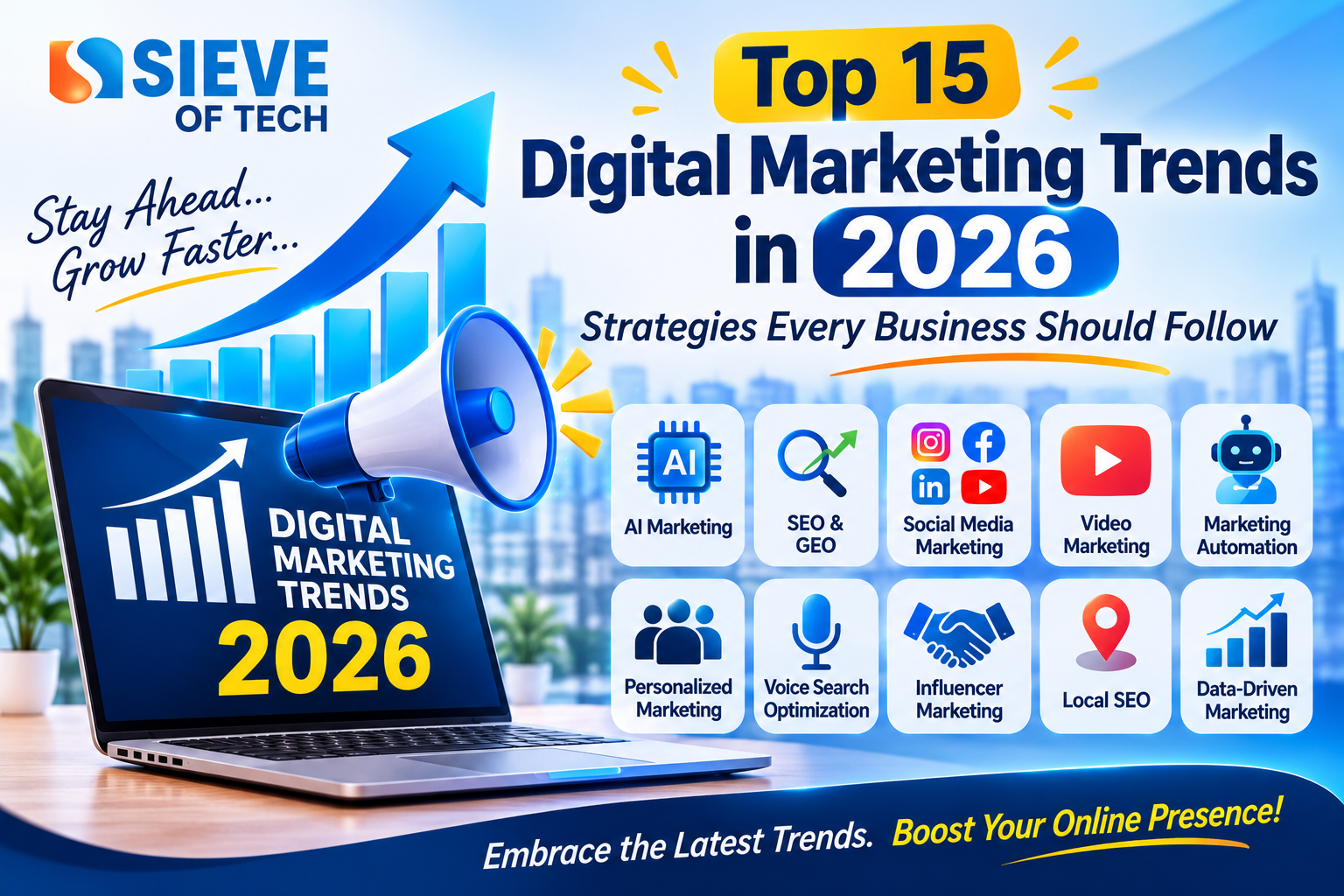
Top Digital Marketing Trends Businesses Should Follow in 2026
Introduction
Digital marketing is changing rapidly. The strategies that helped businesses attract customers a few years ago may not deliver the same results in 2026. Artificial intelligence, changing customer behaviour, social media platforms, voice search and new search technologies are transforming how businesses connect with their audiences.
Today, customers expect more than advertisements. They want useful information, personalised experiences, quick responses and trustworthy brands. Businesses that understand these expectations can build stronger relationships and improve their online presence.
Following the latest digital marketing trends in 2026 can help businesses reach the right audience, generate quality leads, improve website traffic, and increase sales.
Whether you run a small business, startup, e-commerce store, or established company, understanding these trends can help you plan a better marketing strategy.
Let’s explore the top digital marketing trends businesses should follow in 2026.
1. Artificial Intelligence in Digital Marketing
Artificial intelligence (AI) is one of the biggest changes in digital marketing. Businesses are using AI tools to research keywords, generate content ideas, analyse customer behaviour, create advertisements, and automate repetitive tasks.
AI can help marketing teams work faster and make better use of available data.
How businesses can use AI:
- Generate blog and social media content ideas.
- Research keywords and understand search intent.
- Create advertising copy and campaign variations.
- Analyse marketing performance.
- Automate customer support and lead responses.
- Personalise product and service recommendations.
For example, a digital marketing agency can use AI to prepare content outlines, analyse campaign results and identify opportunities. The final content should still be reviewed by people to ensure accuracy, originality and usefulness.
Business tip: Use AI to support your marketing team, not to replace human creativity, experience and quality checks.
2. Generative Engine Optimisation (GEO)
Search behaviour is changing. People increasingly use AI-powered search experiences and conversational tools to find answers, compare products and research services.
This has made Generative Engine Optimisation (GEO) an important topic for businesses in 2026.
Traditional SEO focuses on improving a website’s visibility in search engine results. GEO focuses on making content clear, useful and trustworthy so that AI-powered search experiences can understand and potentially reference it.
How to improve your GEO strategy:
- Publish accurate and helpful information.
- Answer common customer questions directly.
- Use clear headings and structured content.
- Include real examples and expert insights.
- Keep business information consistent.
- Support important claims with reliable sources.
For example, a web development company can publish a detailed guide explaining how businesses should choose a website development partner. Clear answers and useful information can make the content more valuable to both readers and search systems.
GEO should complement SEO rather than replace it.
3. Search Engine Optimisation (SEO) Still Matters
SEO remains an important digital marketing strategy in 2026. Customers still use search engines to discover services, compare businesses and find solutions to their problems.
However, SEO is no longer just about adding keywords to website pages. Search engines aim to provide relevant, helpful and reliable results.
Businesses should focus on:
- Keyword research based on search intent.
- Helpful, original website content.
- Relevant title tags and meta descriptions.
- Clear page headings and internal links.
- Mobile-friendly website design.
- Fast page loading and good user experience.
- Quality backlinks and brand mentions.
- Local SEO for location-based searches.
For example, a company offering digital marketing services in Hyderabad can create useful service pages and location-focused content that clearly explains its services, experience and business details.
Business tip: Focus on answering customer questions and solving real problems instead of publishing content only to target keywords.
4. Short-Form Video Marketing
Short-form videos continue to be an effective way to capture attention and explain products or services. Platforms such as Instagram Reels, YouTube Shorts and other short-video formats give businesses opportunities to reach new audiences.
People often prefer quick, visual explanations over lengthy promotional messages.
Video content ideas for businesses:
- Product demonstrations.
- Before-and-after results.
- Customer testimonials.
- Frequently asked questions.
- Behind-the-scenes videos.
- Industry tips and educational content.
- Team introductions and company updates.
For example, a website development company can create a 30-second video explaining five signs that a business needs a new website.
The video should have a strong opening, useful information, readable captions, and a clear next step.
5. Social Media Marketing and Community Building
Social media is more than a platform for posting promotional images. It gives businesses a way to communicate with customers, answer questions and build communities.
In 2026, businesses should focus on meaningful engagement rather than simply increasing follower counts.
Effective social media practices include:
- Posting consistently.
- Sharing educational and entertaining content.
- Responding to comments and messages.
- Using relevant hashtags naturally.
- Sharing customer stories with permission.
- Creating polls, quizzes and interactive posts.
- Monitoring audience feedback.
For example, a local business can share customer questions, product demonstrations, and helpful tips to build trust with its audience.
A strong social media presence helps customers understand what a business offers and why they should consider it.
6. Personalised Marketing Experiences
Customers are more likely to engage with content that matches their needs and interests. Personalised marketing helps businesses deliver relevant messages to different audience groups.
Businesses can use customer preferences, purchase history and website interactions, where appropriate permissions allow, to improve communication.
Examples of personalised marketing:
- Product recommendations based on previous purchases.
- Email campaigns for specific customer interests.
- Special offers for relevant customer groups.
- Website content tailored to different audiences.
- Follow-up messages based on customer enquiries.
For example, an online clothing store can recommend products based on a customer’s browsing or purchase history.
Personalisation should be transparent and respectful. Businesses must protect customer information and follow applicable privacy requirements.
7. Voice Search and Conversational Search
People increasingly interact with digital devices and search tools using natural language. Instead of typing only short keywords, they may ask complete questions.
For example, a customer might search for:
“Which is the best digital marketing agency for a small business in Hyderabad?”
Businesses should make their content useful for these conversational searches.
Ways to prepare for conversational search:
- Include natural-language questions in content.
- Add useful FAQ sections.
- Write clear and direct answers.
- Use local keywords where relevant.
- Maintain accurate business contact information.
- Make website content easy to navigate.
Voice search optimisation is not a separate replacement for SEO. Clear, accessible, and useful content supports a better search experience across different search methods.
8. Influencer and Creator Marketing
Influencer marketing allows businesses to connect with audiences through creators who have established communities and credibility.
In 2026, businesses should look beyond follower counts. A creator’s audience relevance, engagement, content quality, and trust are important when selecting a partnership.
Types of influencer partnerships:
- Product reviews.
- Sponsored videos.
- Tutorials and demonstrations.
- Brand collaborations.
- Customer experience stories.
- Local creator partnerships.
For example, a restaurant can work with a local food creator to showcase its menu and customer experience.
Businesses should clearly disclose paid partnerships and sponsored content. They should also measure campaign performance using relevant metrics such as enquiries, website visits, and conversions.
9. Data-Driven Marketing and Analytics
Successful marketing requires understanding what is working and what needs improvement. Data-driven marketing helps businesses make decisions based on measurable results rather than assumptions.
Tools such as Google Analytics 4, Google Search Console, and advertising dashboards can help businesses understand their performance.
Important metrics to track:
- Website traffic.
- Organic search clicks and impressions.
- Keyword performance.
- Lead generation.
- Conversion rate.
- Cost per lead.
- Advertising return on investment.
- Social media engagement.
For example, if a business receives many website visitors but very few enquiries, it should review its landing pages, contact forms, service information, and calls to action.
Tracking the right metrics helps businesses improve their marketing budget and strategy.
10. Email Marketing and Automation
Email marketing remains a useful way to communicate with customers and maintain long-term relationships.
Businesses can use automation to send relevant messages at the right time, based on customer actions and preferences.
Useful email campaigns include:
- Welcome emails.
- Enquiry follow-ups.
- Product announcements.
- Educational newsletters.
- Special offers.
- Customer feedback requests.
- Re-engagement campaigns.
For example, when someone subscribes to a business newsletter, an automated welcome email can introduce the company and explain its services.
Businesses should send relevant emails to people who have given appropriate permission and provide a clear way to unsubscribe.
11. Local SEO and Google Business Profile Optimisation
Local SEO is important for businesses that serve customers in a particular city, region or neighbourhood.
Customers often search for nearby services before making a purchase or contacting a company. A complete and accurate Google Business Profile can help businesses appear in relevant local search experiences.
Local SEO activities to prioritise:
- Select accurate business categories.
- Keep the business name, address, and phone number consistent.
- Add genuine business photographs.
- Update business hours and service information.
- Publish useful Google Business Profile updates.
- Respond professionally to customer reviews.
- Create location-relevant website content.
For example, a digital marketing company in Hyderabad can create service pages that explain its SEO, website development and social media marketing services for local businesses.
Local SEO helps customers find accurate information and decide whether a business meets their needs.
12. Conversational Marketing and AI Chatbots
Customers often expect quick answers when they visit a website. If they cannot find the information they need, they may leave and contact another business.
Conversational marketing uses live chat, messaging platforms, and chatbots to make communication easier.
AI-powered chatbots can help businesses:
- Answer frequently asked questions.
- Explain products and services.
- Collect enquiry details.
- Guide visitors to relevant pages.
- Provide basic support outside business hours.
For example, a website visitor looking for SEO services can use a chatbot to understand available packages and submit an enquiry.
Businesses should make it easy to reach a real person when a question is complex or requires personal attention. Chatbots should not provide misleading answers or pretend to be human representatives.
13. Performance Marketing and Smarter Advertising
Paid advertising helps businesses reach potential customers through platforms such as Google Ads, YouTube, and social media advertising networks.
In 2026, businesses should focus on campaign quality, accurate measurement and continuous optimisation rather than spending more money without a clear strategy.
Important performance marketing practices:
- Define a clear campaign objective.
- Understand the target audience.
- Use relevant keywords and audience signals.
- Create multiple ad variations.
- Test landing pages.
- Track conversions accurately.
- Review cost per lead and return on investment.
For example, a business offering website development can run a search campaign targeting people actively looking for website development services.
The campaign should lead visitors to a relevant landing page with clear service details and an easy enquiry option.
14. First-Party Data and Customer Privacy
Privacy and customer trust are becoming increasingly important in digital marketing. Businesses should understand what information they collect, why they collect it and how they use it.
First-party data is information collected directly from customers through interactions such as website enquiries, subscriptions and purchases.
Responsible data practices include:
- Asking for consent where required.
- Explaining how customer data is used.
- Collecting only necessary information.
- Protecting customer records.
- Providing clear privacy policies.
- Following applicable data protection laws.
Building trust is not only a legal responsibility. It can also improve long-term customer relationships.
15. Omnichannel Marketing
Customers may interact with a business through Google Search, social media, email, websites, messaging apps and offline channels before making a decision.
Omnichannel marketing aims to provide a consistent experience across these touchpoints.
For example, a customer may discover a product on Instagram, visit the company website, ask a question through WhatsApp and complete the purchase later.
Businesses should maintain consistent branding, service information, and communication across these channels.
How Businesses Can Build a Digital Marketing Strategy in 2026
Following every trend is not necessary. Businesses should select strategies based on their goals, audience, budget and available resources.
Here is a practical approach:
Step 1: Set clear goals
Decide whether the priority is website traffic, brand awareness, enquiries, online sales or customer retention.
Step 2: Understand your audience
Identify customer needs, problems, interests, and preferred platforms.
Step 3: Improve your website
Make sure your website is mobile-friendly, easy to navigate, fast, and clear about your products or services.
Step 4: Build an SEO foundation
Research relevant keywords, improve website pages and publish useful content regularly.
Step 5: Use social media and video
Choose platforms that your customers use and share content that answers their questions.
Step 6: Use AI and automation carefully
Adopt suitable tools to improve productivity while maintaining human review and quality.
Step 7: Measure results
Review performance regularly and improve campaigns based on real data.
Conclusion
Digital marketing in 2026 is becoming more intelligent, personalised and customer-focused. AI, GEO, SEO, short-form videos, social media, automation, local SEO and data-driven advertising are changing how businesses attract and engage customers.
However, businesses do not need to follow every new trend at once. The best approach is to understand customer needs, choose the right marketing channels, and consistently deliver useful experiences.
By adopting the right digital marketing trends in 2026, businesses can strengthen their online presence, generate quality leads, build customer trust, and support long-term growth.
At SIEVES OF TECH, we help businesses improve their digital presence through SEO, website development, and digital marketing strategies. Choosing the right strategy today can help your business stay competitive tomorrow.
Frequently Asked Questions
1. What are the top digital marketing trends in 2026?
Major trends include AI-powered marketing, GEO, SEO, short-form video, personalised marketing, influencer marketing, marketing automation, local SEO and data-driven advertising.
2. How is AI changing digital marketing in 2026?
AI helps businesses research keywords, create content drafts, analyse data, personalise customer experiences and automate repetitive marketing activities.
3. Is SEO still important in 2026?
Yes. SEO remains important because customers use search engines to discover businesses, compare services, and find solutions. Businesses should focus on useful content, technical performance, and search intent.
4. What is GEO in digital marketing?
GEO stands for Generative Engine Optimisation. It focuses on making content useful and understandable for AI-powered search and answer experiences.
5. Why is video marketing important for businesses?
Video helps businesses demonstrate products, explain services, share customer experiences, and communicate information in an engaging format.
6. How can small businesses use digital marketing?
Small businesses can start with a professional website, local SEO, Google Business Profile optimisation, useful social media content, and targeted advertising.
7. Which digital marketing tools are useful in 2026?
Useful tools include Google Analytics 4, Google Search Console, Semrush, Ahrefs, ChatGPT, Gemini, Canva, and email marketing platforms.
8. What is the importance of local SEO?
Local SEO helps businesses improve visibility for relevant location-based searches and makes it easier for nearby customers to find accurate business information.
9. How often should businesses update their digital marketing strategy?
Businesses should monitor performance regularly and review their overall strategy at least quarterly, or sooner when customer behaviour and business goals change.
10. What is the future of digital marketing?
Digital marketing is likely to become more AI-assisted, personalised, conversational and data-driven, while customer trust, privacy and useful content will remain important.