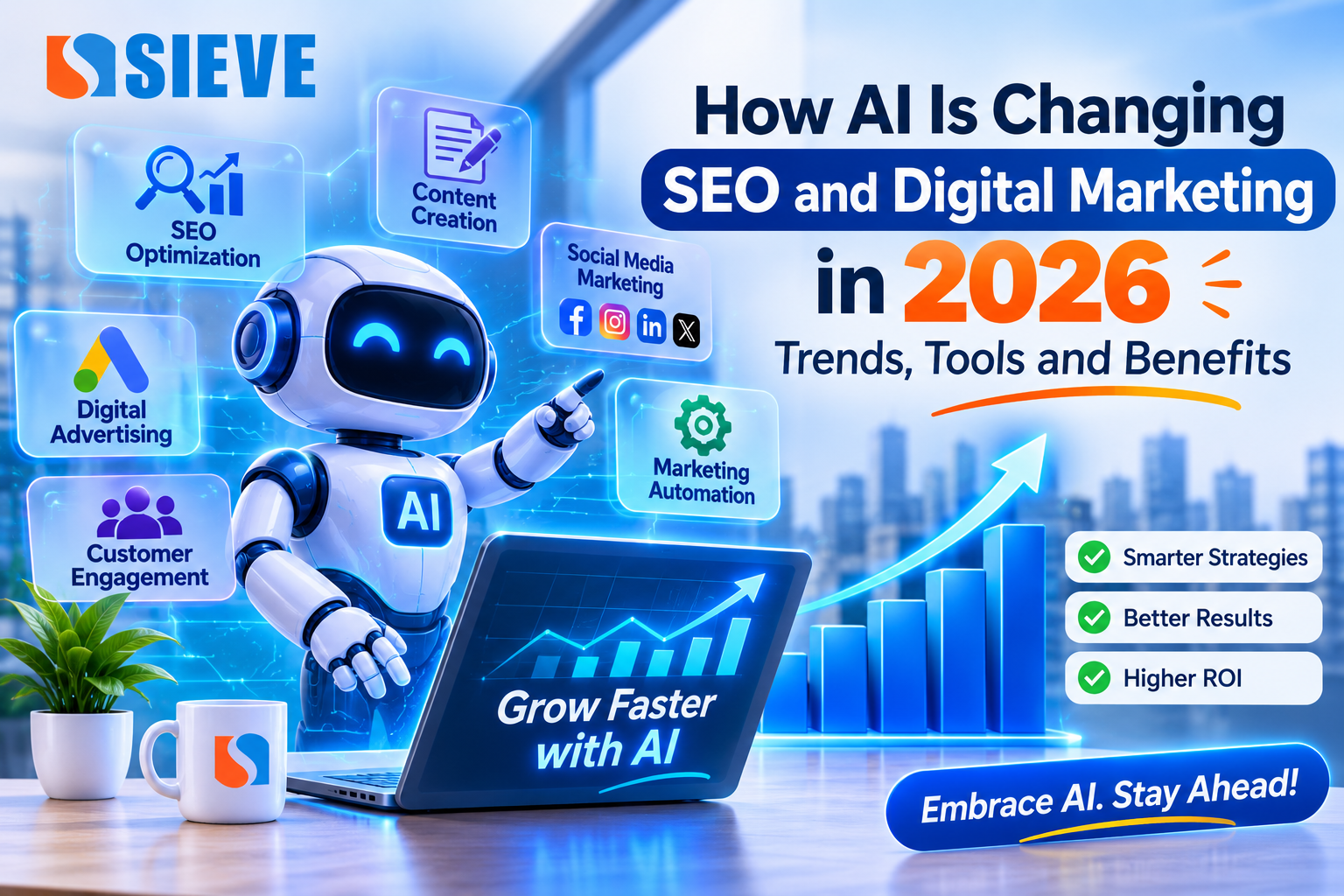
How AI Is Changing SEO and Digital Marketing in 2026
Introduction
Artificial Intelligence (AI) is transforming the digital marketing industry in 2026. Businesses are no longer depending only on traditional marketing methods to reach customers. They are using AI-powered tools to understand customer behaviour, create content, improve search engine rankings, manage advertising campaigns, and generate quality leads.
From ChatGPT and Google AI Overviews to AI-powered marketing automation platforms, artificial intelligence is changing how people discover information and interact with brands.
Earlier, digital marketers spent hours researching keywords, writing blog posts, analyzing website traffic, and managing advertising campaigns. Today, AI tools can assist with many of these activities, helping marketing teams work faster and make better use of their data.
According to HubSpot’s 2026 State of Marketing research, AI-powered personalization, automation, and adapting SEO for changing search experiences are among the leading marketing priorities. This reflects how AI is becoming part of everyday marketing operations.
But AI is not simply about generating content faster. It is changing how businesses approach search engine optimization, social media marketing, paid advertising, customer experience, and online brand visibility.
In this article, we will explore how AI is changing SEO and digital marketing in 2026, its major benefits, practical applications, challenges, and strategies businesses can use to stay competitive.
What Is AI in Digital Marketing?
AI in digital marketing refers to the use of artificial intelligence technologies to plan, execute, analyze, and improve marketing activities.
These technologies can process large amounts of data, recognize patterns, understand customer queries, generate content, and support marketing decisions.
AI-powered marketing tools can help businesses with:
- Keyword research and SEO analysis.
- Blog writing and content optimization.
- Social media content creation.
- Email marketing automation.
- Customer behaviour analysis.
- Paid advertising optimization.
- Lead generation and management.
- Customer support and personalization.
- Marketing performance reporting.
For example, a digital marketing agency can use AI to research blog topics, identify relevant keywords, prepare content outlines, and analyze campaign performance.
However, human expertise remains important. Marketers need to review AI-generated information, verify facts, maintain brand consistency, and make strategic decisions.
10 Ways AI Is Changing SEO and Digital Marketing in 2026
1. AI Is Changing Search Engine Optimization
Search engine optimization is evolving as people increasingly use AI-powered search experiences to find answers.
Traditional SEO mainly focuses on improving website visibility in search engine results. AI-powered search experiences can also provide summarized answers, recommendations, and links to relevant sources.
Businesses must therefore create content that serves both traditional search users and people using AI-assisted discovery.
Important SEO activities include:
- Understanding search intent.
- Creating helpful and original content.
- Optimizing page titles and meta descriptions.
- Improving website speed and mobile usability.
- Building relevant backlinks.
- Organizing content with clear headings.
- Maintaining accurate business information.
For example, instead of targeting only the keyword “digital marketing agency,” a business can create useful content answering questions such as “How do I choose the right digital marketing agency for my business?”
This approach helps address real customer needs and supports broader search visibility.
2. AI Search and Generative Engine Optimization (GEO)
One of the important developments in 2026 is the growth of AI-powered search and conversational discovery.
People increasingly ask detailed questions through AI platforms rather than relying only on traditional keyword searches.
For example, a user may ask:
“Which digital marketing strategies can help a small business generate more leads?”
An AI search platform may provide a summarized answer using information from different sources.
This has increased interest in Generative Engine Optimization (GEO).
GEO focuses on improving the chances that a business’s content or brand will be referenced in AI-generated answers.
Businesses can prepare for AI-powered search by:
- Publishing accurate and informative content.
- Answering customer questions directly.
- Demonstrating industry expertise.
- Using clear headings and structured information.
- Maintaining a trustworthy online presence.
- Publishing original research and practical examples.
GEO does not replace SEO. Both approaches can work together to improve online discovery.
3. AI Is Making Content Marketing Faster
Content marketing is one of the areas where AI has made a significant difference.
Creating high-quality blog posts, website content, social media captions, and marketing materials requires research and planning.
AI tools can help marketers generate ideas, create outlines, prepare first drafts, improve grammar, and repurpose existing content.
For example, a business publishing a blog about website development can use AI to create:
- Social media posts.
- Short video scripts.
- Email newsletters.
- Frequently asked questions.
- Infographic concepts.
- Content summaries.
This allows businesses to distribute their information across multiple marketing channels.
However, publishing large amounts of generic AI-generated content is not a good content strategy.
Businesses should add original insights, practical examples, expert opinions, and verified information to make their content valuable.
4. AI Is Improving Social Media Marketing
Social media platforms are important channels for businesses to connect with customers and build brand awareness.
AI tools help marketing teams plan content, analyze engagement, identify trends, and prepare creative materials.
Businesses can use AI for:
- Instagram caption generation.
- Facebook post ideas.
- LinkedIn content planning.
- Reels and short-video scripts.
- Hashtag research.
- Audience analysis.
- Social media performance reporting.
For example, a digital marketing agency can use AI to develop a monthly social media calendar for a client.
AI can also help identify which types of posts receive better engagement.
However, successful social media marketing still requires creativity, authentic communication, and an understanding of the target audience.
5. AI Is Transforming Paid Advertising
Paid advertising through Google Ads, Meta Ads, and other digital platforms is becoming increasingly data-driven.
AI-powered advertising systems can help analyze audience signals, optimize bidding, identify opportunities, and support creative testing.
Marketers can use AI to:
- Generate advertising headlines.
- Prepare different ad copy variations.
- Analyze campaign performance.
- Identify audience segments.
- Improve creative testing.
- Support budget allocation.
- Generate campaign reports.
For example, an online education company running Google Ads can test multiple headlines and descriptions to identify which messages attract more relevant enquiries.
AI can support campaign optimization, but marketers must still monitor spending, lead quality, conversion tracking, and return on advertising investment.
6. AI Is Making Marketing More Personalized
Modern customers expect businesses to understand their needs and provide relevant experiences.
AI makes it easier for businesses to analyze customer interactions and deliver more personalized marketing communication.
Examples include:
- Personalized email recommendations.
- Product suggestions based on customer interests.
- Customized website experiences.
- Relevant advertising messages.
- Automated customer follow-ups.
- Audience segmentation.
For example, an e-commerce website can recommend products based on a customer’s browsing activity and previous purchases.
Personalization should always respect customer privacy and applicable data protection requirements.
The goal is to make customer communication more useful, not intrusive.
7. AI Chatbots Are Improving Customer Support
Customer support plays an important role in building customer trust.
Traditional support teams often handle repetitive questions about services, pricing, appointments, delivery, and order status.
AI-powered chatbots can answer common questions, collect customer information, and guide visitors toward relevant services.
For example, a website development company can use an AI chatbot to ask visitors about their project requirements, preferred budget, and expected timeline.
The chatbot can then organize the information and forward the enquiry to the sales team.
Benefits include:
- Faster responses.
- Support outside regular business hours.
- Better enquiry management.
- Reduced repetitive work.
- Improved customer communication.
Businesses should provide a clear option to contact a human representative when an enquiry requires personal attention or complex decision-making.
8. AI Is Helping Businesses Generate Quality Leads
Lead generation is one of the main objectives of digital marketing.
Businesses want to attract people who are genuinely interested in their products or services.
AI tools can help analyze customer behaviour, organize enquiries, identify potential customers, and support follow-up activities.
For example, a marketing agency can connect website enquiry forms with a CRM platform and use AI to summarize incoming leads.
The sales team can review the information and prioritize follow-ups.
AI-assisted lead generation can support:
- Lead categorization.
- Customer enquiry analysis.
- Automated follow-up drafts.
- CRM data organization.
- Lead scoring assistance.
- Sales performance reporting.
The quality of the data and the accuracy of the workflow are important for achieving useful results.
9. AI Is Improving Digital Marketing Analytics
Digital marketing generates large amounts of performance data.
Marketers need to understand website traffic, search rankings, social media engagement, advertising costs, and conversions.
AI-powered analytics tools can help summarize information and identify patterns that may require attention.
For example, an AI assistant can help a marketing team understand:
- Which pages attract more visitors?
- Which keywords generate organic traffic?
- Which advertising campaigns produce enquiries?
- Which social media posts receive more engagement?
- Where are potential customers leaving the website?
These insights can help marketers make more informed decisions.
However, AI-generated analysis should be checked against the original data before important business decisions are made.
10. AI Agents Are Automating Marketing Workflows
AI agents are becoming an important part of business and marketing automation.
Unlike simple automation tools that follow fixed rules, AI agents can interpret instructions, work with connected applications, and complete multi-step tasks within defined permissions.
For example, a marketing workflow may involve:
- Finding relevant blog topics.
- Preparing a content outline.
- Drafting a blog article.
- Creating social media captions.
- Preparing an email newsletter.
- Summarizing campaign performance.
AI agents can assist with several stages of this workflow.
Human marketers should review content, approve important actions, and ensure that all published information meets brand and quality standards.
Top AI Digital Marketing Trends in 2026
AI adoption is moving beyond experimentation into everyday marketing operations. Industry reports highlight several important trends.
| AI marketing trend | Business opportunity |
|---|---|
| AI-powered SEO | Improve content research and search visibility |
| Generative Engine Optimization | Prepare content for AI-powered discovery |
| AI content creation | Speed up content planning and production |
| Marketing automation | Reduce repetitive marketing tasks |
| AI agents | Coordinate multi-step marketing workflows |
| Personalized marketing | Deliver more relevant customer experiences |
| AI-powered advertising | Support campaign optimization |
| Predictive analytics | Identify patterns and support planning |
| AI chatbots | Improve customer communication |
| AI video creation | Support short-form video and creative production |
The 2026 marketing landscape is not just about using more AI tools. Businesses need to connect AI with clear marketing objectives, useful content, customer data, and measurable outcomes.
Best AI Tools for Digital Marketing in 2026
Businesses can choose from several AI-powered tools depending on their marketing requirements.
1. ChatGPT
Useful for blog outlines, content ideas, keyword research assistance, marketing strategies, and social media content.
2. Google Gemini
Useful for research assistance, brainstorming, content development, and working with information across different tasks.
3. Canva AI
Useful for social media graphics, presentations, marketing designs, and visual content creation.
4. Semrush
Useful for SEO research, competitor analysis, keyword tracking, and website optimization.
5. Grammarly
Useful for checking grammar, improving readability, and polishing marketing content.
6. HubSpot
Useful for CRM, marketing automation, lead management, and customer relationship activities.
7. Google Analytics 4
Useful for tracking website visitors, engagement, traffic sources, and conversions, with additional analysis capabilities.
The right tools depend on your business size, budget, team capabilities, and marketing goals. Using too many tools without a clear workflow can increase costs without improving results.
Benefits of Using AI in Digital Marketing
AI can provide several advantages when businesses use it effectively.
1. Saves Time: AI can speed up research, content preparation, reporting, and repetitive marketing activities.
2. Reduces Manual Work: Automation can help manage routine tasks and allow employees to focus on more important responsibilities.
3. Improves Productivity: Marketing teams can use AI to complete more work while maintaining human review and quality control.
4. Supports Better Decisions: AI-assisted analytics can help identify trends and provide useful insights from marketing data.
5. Enhances Customer Experience: Personalized communication and automated support can make interactions more relevant and convenient.
6. Supports Business Growth: Better marketing workflows can help businesses manage campaigns, generate enquiries, and improve operational efficiency.
The actual benefits depend on implementation quality, data accuracy, and the way AI tools are integrated into business processes.
Challenges of AI in SEO and Digital Marketing
Although AI offers many opportunities, businesses should also understand its limitations.
1. Generic AI-Generated Content
Publishing repetitive or low-quality AI content can reduce the value of a website. Businesses should focus on originality and genuine expertise.
2. Incorrect Information
AI tools can generate inaccurate facts, statistics, and recommendations. Always verify important information before publishing.
3. Data Privacy Concerns
Businesses must protect customer information and avoid sharing sensitive data with AI platforms without appropriate safeguards.
4. Overdependence on AI
AI should support marketing teams, not replace strategic thinking, creativity, and human judgment.
5. Increasing Competition
As more businesses use AI to create content and advertisements, standing out becomes more challenging.
6. Measuring AI Performance
Businesses should track measurable outcomes such as qualified leads, conversions, customer engagement, and campaign ROI instead of focusing only on the number of tasks automated.
How Businesses Can Use AI to Improve Digital Marketing
Businesses do not need to transform their entire marketing department at once.
They can start with a few practical steps:
Step 1: Identify Marketing Challenges
Find tasks that take too much time, such as content planning, lead management, reporting, or customer communication.
Step 2: Choose the Right AI Tools
Select tools based on your specific requirements, budget, privacy needs, and existing marketing systems.
Step 3: Improve Your SEO Strategy
Use AI to support keyword research, content planning, website analysis, and search intent research.
Step 4: Create Useful Content
Develop blogs, landing pages, videos, and social media posts that answer real customer questions.
Step 5: Automate Repetitive Activities
Start with simple workflows such as email notifications, enquiry organization, and report preparation.
Step 6: Maintain Human Quality Control
Review AI-generated content, check facts, protect customer information, and approve important actions.
Step 7: Track Performance
Measure organic traffic, qualified enquiries, conversion rates, campaign performance, and customer satisfaction.
The Future of AI in SEO and Digital Marketing
The future of digital marketing will involve closer collaboration between human marketers and AI-powered systems.
AI agents, conversational search, personalized experiences, and automated marketing workflows are expected to play an increasingly important role.
Businesses will need to focus on more than just search engine rankings. Brand credibility, customer trust, original content, and visibility across different discovery platforms will become increasingly important.
Human creativity will also remain valuable. AI can generate ideas and support execution, but understanding customer emotions, developing brand identity, and creating meaningful relationships require human judgment.
Companies that combine AI technology with strong marketing fundamentals will be better prepared to adapt to changes in customer behaviour.
Conclusion
AI is changing SEO and digital marketing in 2026 by improving content creation, search optimization, advertising, social media management, customer support, analytics, and business automation.
Businesses can use AI to save time, improve productivity, understand customers, and develop more effective marketing strategies.
However, successful digital marketing is not about using AI for everything. It is about choosing the right tools, creating valuable content, maintaining customer trust, and measuring actual business results.
For businesses looking to improve their online presence, combining traditional SEO with AI-powered marketing strategies can create new opportunities for sustainable growth.
Want to improve your business’s digital marketing performance?
Sieve Softech helps businesses explore digital marketing, SEO, website development, and technology-driven solutions. Build a smarter digital strategy and take the next step toward growing your online presence.
Frequently Asked Questions (FAQs)
1. How is AI changing digital marketing in 2026?
AI is changing digital marketing through automated content creation, SEO research, personalized advertising, social media management, customer support, analytics, and marketing automation.
2. How is AI used in SEO?
AI helps marketers with keyword research, content planning, search intent analysis, competitor research, technical SEO assistance, and content optimization.
3. Will AI replace digital marketers?
No. AI can automate repetitive activities and support marketing decisions, but human creativity, strategic planning, communication, and customer understanding remain important.
4. What are the best AI tools for digital marketing?
Popular tools include ChatGPT, Google Gemini, Canva AI, Semrush, Grammarly, HubSpot, and Google Analytics 4. The best choice depends on the marketing task and business requirements.
5. Can AI improve website rankings on Google?
AI can support SEO activities such as research, content planning, and website analysis. However, using AI does not guarantee higher Google rankings. Helpful content, relevance, technical quality, and other search ranking systems remain important.
6. What is the difference between AI SEO and traditional SEO?
Traditional SEO focuses on improving organic search visibility through content, technical optimization, and authority. AI-assisted SEO uses artificial intelligence to support research, analysis, and optimization activities.
7. Is AI content good for SEO?
AI-generated content can support SEO when it is accurate, original, helpful, and created for users. Publishing unedited, repetitive, or low-value content is not a reliable SEO strategy.
8. How can small businesses use AI in digital marketing?
Small businesses can use AI for blog planning, social media captions, customer support, email marketing, keyword research, lead management, and campaign reporting.
9. What is the future of AI in digital marketing?
The future will include more AI-powered search, intelligent automation, personalized customer experiences, AI agents, predictive analytics, and stronger integration between marketing platforms.
10. Should businesses invest in AI digital marketing?
Businesses should consider AI when it solves a real marketing problem, improves productivity, supports customer experience, or produces measurable business value. Start with specific goals and evaluate the results.