AI Agents and Business Automation: How AI Is Transforming Modern Businesses
Introduction
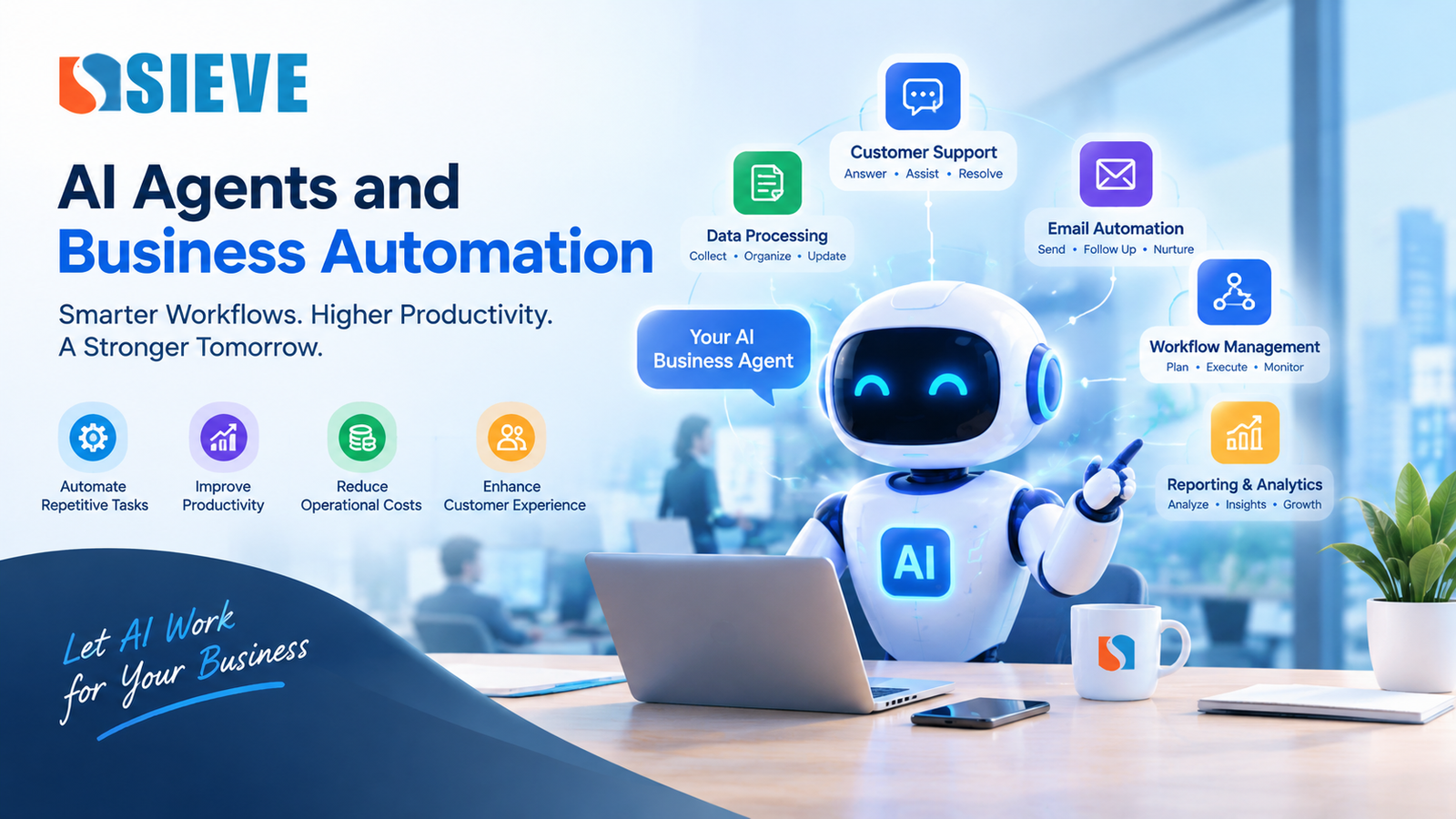
Artificial Intelligence (AI) is changing the way businesses operate, communicate with customers, and manage everyday tasks. From automated customer support to intelligent data analysis, AI-powered technologies help companies save time, cut operational costs, and boost productivity.
One of the most exciting developments in this field is the rise of AI agents.
Unlike traditional automation tools that follow predefined instructions, AI agents can understand requests, analyze information, make decisions within defined boundaries, and perform multiple tasks to achieve specific goals. Businesses are increasingly exploring AI agents to automate repetitive workflows, improve customer experiences, and support faster decision-making.
Business automation is no longer limited to large enterprises. Small businesses, startups, and growing companies can also use AI-powered solutions to streamline their operations.
But what exactly are AI agents? How do they work? What are their benefits, and how can businesses implement them effectively?
In this guide, we will explore AI agents and business automation, their practical applications, benefits, challenges, and future opportunities.
What Are AI Agents?
AI agents are software systems that use artificial intelligence to perform tasks, respond to instructions, and work toward specific objectives with varying levels of independence.
They can process information, understand natural language, use connected tools, and complete tasks based on predefined goals and permissions.
For example, imagine a business receives hundreds of customer enquiries every day. A traditional chatbot may provide answers to frequently asked questions using predefined responses. An AI agent can go further by understanding a customer’s request, checking relevant information, creating a support ticket, and routing the enquiry to the appropriate team.
AI agents can be designed for individual tasks or connected to multiple systems to manage larger workflows.
How Do AI Agents Work?
AI agents typically combine several technologies to perform tasks.
1. Natural Language Processing (NLP)
Natural Language Processing helps AI agents understand and respond to human language. It allows users to communicate with software using everyday language instead of complicated commands.
2. Machine Learning
Machine learning helps AI systems identify patterns, process information, and improve performance through data and model development.
3. Large Language Models (LLMs)
Large Language Models help AI agents understand context, interpret instructions, generate responses, and plan parts of a task.
4. Tools and Integrations
AI agents can connect with business applications such as CRM platforms, databases, email systems, calendars, and project management software.
5. Planning and Decision-Making
Some AI agents can break a larger objective into smaller steps, decide which tools to use, and evaluate whether the task has been completed successfully.
The level of independence depends on the system’s design, permissions, and human oversight.
What Is Business Automation?
Business automation is the use of software and technology to perform repetitive business processes with minimal manual effort.
Instead of employees spending hours on routine activities, automated systems can handle specific tasks according to predefined rules or intelligent instructions.
For example, when a customer submits an enquiry through a website, an automated workflow can capture the details, add the contact to a CRM system, assign the enquiry to a salesperson, and send an acknowledgement email.
Business automation can improve efficiency while allowing employees to focus on activities that require creativity, communication, and decision-making.
Common Areas of Business Automation
- Customer relationship management (CRM).
- Email marketing and communication.
- Invoice processing and payment reminders.
- Employee onboarding.
- Sales lead management.
- Customer support.
- Inventory management.
- Business reporting and analytics.
- Appointment scheduling.
- Data entry and document processing.
Combining traditional automation with AI agents can make these processes more flexible and capable of handling complex requests.
AI Agents vs Traditional Business Automation
AI agents and traditional automation both help businesses reduce manual work, but they operate differently.
Traditional automation generally follows predefined rules and workflows. AI agents can interpret information, handle certain variations, and choose between available actions within their permitted scope.
Here is a comparison:
| Factor | Traditional Automation | AI Agents |
|---|---|---|
| Working method | Follows predefined rules | Uses AI to interpret goals and select actions |
| Decision-making | Rule-based | Context-aware within defined limits |
| Flexibility | Best for predictable tasks | Can handle some changing situations |
| Data processing | Mainly structured information | Can work with structured and unstructured information |
| Communication | Predefined messages | More flexible natural-language interaction |
| Adaptability | Requires workflow updates | Can respond to different inputs, depending on design |
| Complexity | Suitable for repetitive workflows | Useful for multi-step tasks |
| Human involvement | Needed for exceptions | Needed for supervision and sensitive decisions |
For example, a traditional automation system can send a reminder email three days after a customer enquiry. An AI agent may review the enquiry, understand its context, prepare a relevant follow-up message, and recommend the next action.
However, AI agents are not always the better option. Simple, predictable processes are often cheaper and more reliable with traditional automation.
Benefits of AI Agents and Business Automation
AI-powered business automation offers several advantages when implemented with the right processes and controls.
1. Increased Productivity
Employees often spend considerable time completing repetitive tasks such as responding to routine enquiries, updating records, preparing reports, and organizing information.
AI agents can assist with these activities, allowing employees to spend more time on important business responsibilities.
For example, a sales team can use an AI agent to summarize customer conversations, organize lead information, and prepare follow-up drafts.
2. Reduced Operational Costs
Manual business processes require time and resources. Automating suitable tasks can reduce repetitive work and improve resource utilization.
Businesses may save costs by automating routine administrative activities, customer communication, and document processing.
Actual savings depend on implementation costs, maintenance, integration requirements, and the number of tasks successfully automated.
3. Improved Customer Experience
Customers expect quick and helpful responses when interacting with businesses.
AI-powered support systems can provide assistance outside regular working hours, answer common questions, and route complicated requests to human employees.
This can improve response times while helping support teams manage larger enquiry volumes.
4. Better Data Management
Businesses collect information from websites, emails, customer conversations, sales platforms, and internal systems.
AI agents can help organize this information, summarize important details, and identify patterns that support business decisions.
For example, an AI-powered reporting assistant can summarize sales performance and highlight changes that require attention.
5. Faster Business Processes
Automating multiple connected activities can reduce delays between departments.
An automated recruitment workflow, for example, can collect applications, organize candidate information, and notify the recruitment team when new applications arrive.
This helps teams manage routine processes more efficiently.
6. Scalability
As a business grows, the volume of customer enquiries, transactions, and administrative tasks also increases.
Well-designed automation systems can handle additional workloads without requiring every task to be completed manually.
Businesses should still monitor system capacity, service quality, and costs as usage increases.
Practical Applications of AI Agents Across Different Industries
AI agents are being explored across many industries. Their applications depend on the business’s requirements, available data, and existing software systems.
1. AI Agents in Customer Support
Customer support is one of the most common areas for AI-powered automation.
AI agents can:
- Answer frequently asked questions.
- Help customers find relevant products or services.
- Collect customer information.
- Check order or enquiry status through connected systems.
- Create and categorize support tickets.
- Transfer complex issues to human representatives.
For example, an online business can use an AI support agent to answer delivery-related questions and forward payment disputes to the appropriate support employee.
2. AI Agents in Sales and Marketing
Sales and marketing teams manage large amounts of customer information and communication.
AI agents can support activities such as:
- Organizing incoming leads.
- Summarizing customer enquiries.
- Drafting personalized follow-up emails.
- Preparing campaign reports.
- Supporting customer segmentation.
- Identifying potential sales opportunities.
For a digital marketing agency, an AI agent could summarize campaign performance and prepare a draft report for a marketing specialist to review.
3. AI Agents in Human Resources
HR departments manage recruitment, employee onboarding, attendance-related communication, and internal documentation.
AI agents can assist with:
- Organizing candidate applications.
- Answering routine employee questions.
- Preparing onboarding checklists.
- Scheduling interviews.
- Summarizing recruitment information.
- Managing internal HR documentation.
Human HR professionals should remain responsible for important recruitment decisions and sensitive employee matters.
4. AI Agents in Finance and Accounting
Finance departments handle repetitive processes involving invoices, expenses, and financial documents.
AI-powered automation can help with:
- Extracting invoice information.
- Organizing expense records.
- Identifying missing documentation.
- Preparing payment reminders.
- Generating financial summaries.
- Flagging unusual transactions for review.
Sensitive financial approvals and payment decisions should have appropriate authorization and human oversight.
5. AI Agents in IT and Software Development
Technology companies can use AI agents to support software development and IT operations.
Common applications include:
- Code assistance and documentation.
- Software testing support.
- Bug report classification.
- IT helpdesk responses.
- System monitoring assistance.
- Technical documentation summaries.
Developers should review AI-generated code, test changes, and follow security standards before deploying software.
How to Implement AI Agents in Your Business
Implementing AI agents requires more than choosing an AI tool. Businesses need a clear strategy that connects automation with actual operational requirements.
Here are seven practical steps.
Step 1: Identify Repetitive Business Tasks
Start by identifying activities that consume significant employee time.
Examples include customer enquiries, data entry, appointment scheduling, report preparation, and document processing.
Choose tasks that are repetitive, measurable, and suitable for automation.
Step 2: Define Clear Business Goals
Decide what you want to achieve through AI automation.
Possible objectives include:
- Reducing customer response times.
- Improving lead management.
- Reducing manual data entry.
- Increasing employee productivity.
- Improving reporting accuracy.
Set measurable targets before implementing the system.
Step 3: Choose the Right AI Agent Solution
Select an AI solution based on your business needs, available integrations, security requirements, and budget.
Some businesses may need a simple AI assistant, while others may benefit from more advanced AI agents connected to multiple applications.
Step 4: Integrate Existing Business Systems
AI agents become more useful when they can access relevant business information through secure integrations.
Depending on your requirements, integrations may include:
- CRM software.
- Email platforms.
- Website forms.
- Customer support systems.
- Business databases.
- Project management tools.
Only provide the permissions and data access required for the agent’s assigned tasks.
Step 5: Establish Human Oversight
AI agents can make mistakes, misunderstand instructions, or produce incorrect information.
Define which activities can be completed automatically and which require human approval.
For example, an AI agent may prepare a customer refund recommendation, but an authorized employee should approve the actual refund.
Step 6: Test the Automation Workflow
Before introducing an AI agent across your organization, test it with realistic business scenarios.
Evaluate its accuracy, response quality, processing time, security, and ability to handle unexpected situations.
Start with a small pilot project and improve the workflow based on feedback.
Step 7: Monitor and Improve Performance
Review the system regularly to ensure it continues to meet business objectives.
Track metrics such as:
- Average task completion time.
- Customer response time.
- Automation success rate.
- Error and escalation rate.
- Cost per completed task.
- Employee productivity.
- Customer satisfaction.
Use these results to identify opportunities for improvement.
Challenges of AI Agents and Business Automation
Although AI agents offer useful capabilities, businesses should understand their limitations before adopting them.
1. Data Privacy and Security
AI agents may access customer information, business documents, and internal databases. Organizations must establish access controls, encryption, data protection policies, and appropriate vendor agreements.
2. Implementation Costs
Advanced AI automation may require software subscriptions, development resources, integration work, and ongoing maintenance. Businesses should evaluate the total cost before implementation.
3. Incorrect AI Responses
AI systems can produce inaccurate or misleading information. Important business decisions should not rely entirely on unverified AI outputs.
4. Integration Complexity
Connecting AI agents with existing business applications may require technical expertise, API access, and workflow changes.
5. Employee Training
Employees need to understand how AI tools work, when to use them, and when human intervention is necessary.
6. Compliance and Governance
Businesses must consider applicable privacy, security, and industry regulations when using AI systems, especially when handling sensitive information.
Addressing these challenges early can help organizations adopt AI automation more responsibly.
The Future of AI Agents and Business Automation
The future of business automation is moving toward more connected and intelligent systems.
AI agents are expected to become increasingly capable of coordinating tasks across multiple applications, supporting business teams, and managing complex workflows under defined permissions.
Some emerging developments include:
Multi-Agent Systems: Multiple specialized AI agents can collaborate on different parts of a larger business process.
AI-Powered Personalization: Businesses can use AI to understand customer preferences and support more relevant interactions.
Intelligent Workflow Management: AI systems can help identify process delays, organize tasks, and recommend improvements.
AI-Assisted Decision Support: Business leaders can use AI tools to summarize information, compare scenarios, and support planning.
Human-AI Collaboration: Employees and AI systems will increasingly work together, with people responsible for judgment, accountability, and important decisions.
The biggest opportunity is not simply replacing manual work. It is improving how people and technology work together to achieve business goals.
Conclusion
AI agents and business automation are changing the way modern organizations manage daily operations. From customer support and sales to HR, finance, and software development, AI-powered systems can help businesses improve efficiency, reduce repetitive work, and deliver better customer experiences.
However, successful automation requires the right strategy. Businesses should identify suitable processes, choose reliable AI solutions, integrate existing systems securely, and maintain human oversight.
AI agents are not a replacement for every employee or business process. They are tools that can support teams and improve productivity when used responsibly.
For businesses looking to stay competitive, now is a good time to explore how AI automation can simplify operations and support long-term growth.
Looking to improve your business operations with modern technology? Sieve Softech helps businesses explore digital solutions, software development, and technology-driven growth opportunities. Visit our website to learn more about the services that can support your business goals.
Frequently Asked Questions (FAQs)
1. What are AI agents in business?
AI agents are intelligent software systems that can understand instructions, process information, use connected tools, and perform tasks toward specific business objectives.
2. How do AI agents help businesses?
AI agents can help businesses automate customer support, organize leads, process documents, summarize reports, manage workflows, and reduce repetitive manual tasks.
3. What is the difference between AI agents and automation?
Traditional automation follows predefined rules and workflows. AI agents can interpret context, handle different inputs, and select actions within their assigned permissions.
4. Can small businesses use AI agents?
Yes. Small businesses can use AI agents for customer enquiries, appointment scheduling, lead management, email assistance, and administrative tasks. They can start with simple solutions and expand as their requirements grow.
5. Are AI agents expensive to implement?
Costs vary depending on the technology, integrations, complexity, usage, and maintenance requirements. Some businesses can begin with affordable AI tools, while advanced custom solutions require greater investment.
6. Are AI agents safe for business use?
AI agents can be used safely when businesses implement appropriate security measures, access restrictions, data protection policies, testing, and human approval for sensitive actions.
7. Which industries can benefit from AI automation?
Industries such as healthcare administration, retail, banking, education, manufacturing, IT, real estate, and digital marketing can benefit from suitable AI automation solutions.
8. What is the future of AI agents?
AI agents are expected to become more capable of coordinating tasks, connecting business applications, supporting decision-making, and collaborating with employees across different departments.