Google Ads vs Meta Ads: Which Is Better for Lead Generation?
Introduction
Generating quality leads is one of the biggest challenges for businesses in today’s competitive online market. Whether you run a small business, a startup, a healthcare organisation, an educational institution or a large company, finding potential customers is essential for business growth.
Digital advertising platforms such as Google Ads and Meta Ads help businesses reach potential customers, promote their services and generate enquiries. However, both platforms work differently.
Google Ads helps businesses reach people who are actively searching for products or services. Meta Ads, which includes Facebook and Instagram advertising, helps businesses reach people based on their interests, behaviour, and other audience signals.
So, Google Ads vs Meta Ads: Which Is Better for Lead Generation?
The answer depends on your business, target audience, advertising budget, and marketing goals. In this guide, we compare both platforms and explain how to choose the right advertising strategy.
1. What Is Google Ads?
Google Ads is an online advertising platform that allows businesses to promote their products and services across Google’s advertising network.
One of its most popular formats is Google Search Ads. These advertisements can appear when people search for specific products, services, or solutions on Google.
For example, someone searching for:
- Digital marketing agency in Hyderabad
- Website development company near me
- Best SEO services in Hyderabad
- Hospital appointment near me
- Real estate consultants in Hyderabad
may see relevant sponsored advertisements in the search results.
How Google Ads works:
- A business selects relevant keywords.
- It creates advertisements related to those keywords.
- It sets campaign budgets and bidding strategies.
- Google runs an advertising auction when relevant searches occur.
- Potential customers click the advertisement and visit the website, call, or submit an enquiry.
Best for: Businesses offering products or services that customers actively search for.
2. What Are Meta Ads?
Meta Ads are paid advertisements displayed across platforms such as Facebook and Instagram, along with other eligible Meta placements.
Unlike Google Search Ads, Meta Ads do not depend primarily on users searching for specific keywords. Instead, advertisements are delivered using audience information, interests, behaviours, campaign objectives, and Meta’s delivery systems.
For example, a digital marketing agency can show an advertisement about SEO services to audiences who may be interested in business growth and online marketing.
Popular Meta Ads formats include:
- Image advertisements.
- Video advertisements.
- Instagram Reels advertisements.
- Story advertisements.
- Carousel advertisements.
- Facebook lead form advertisements.
- Click-to-WhatsApp advertisements.
Best for: Businesses that want to introduce their products or services, build brand awareness, reach new audiences, and generate enquiries.
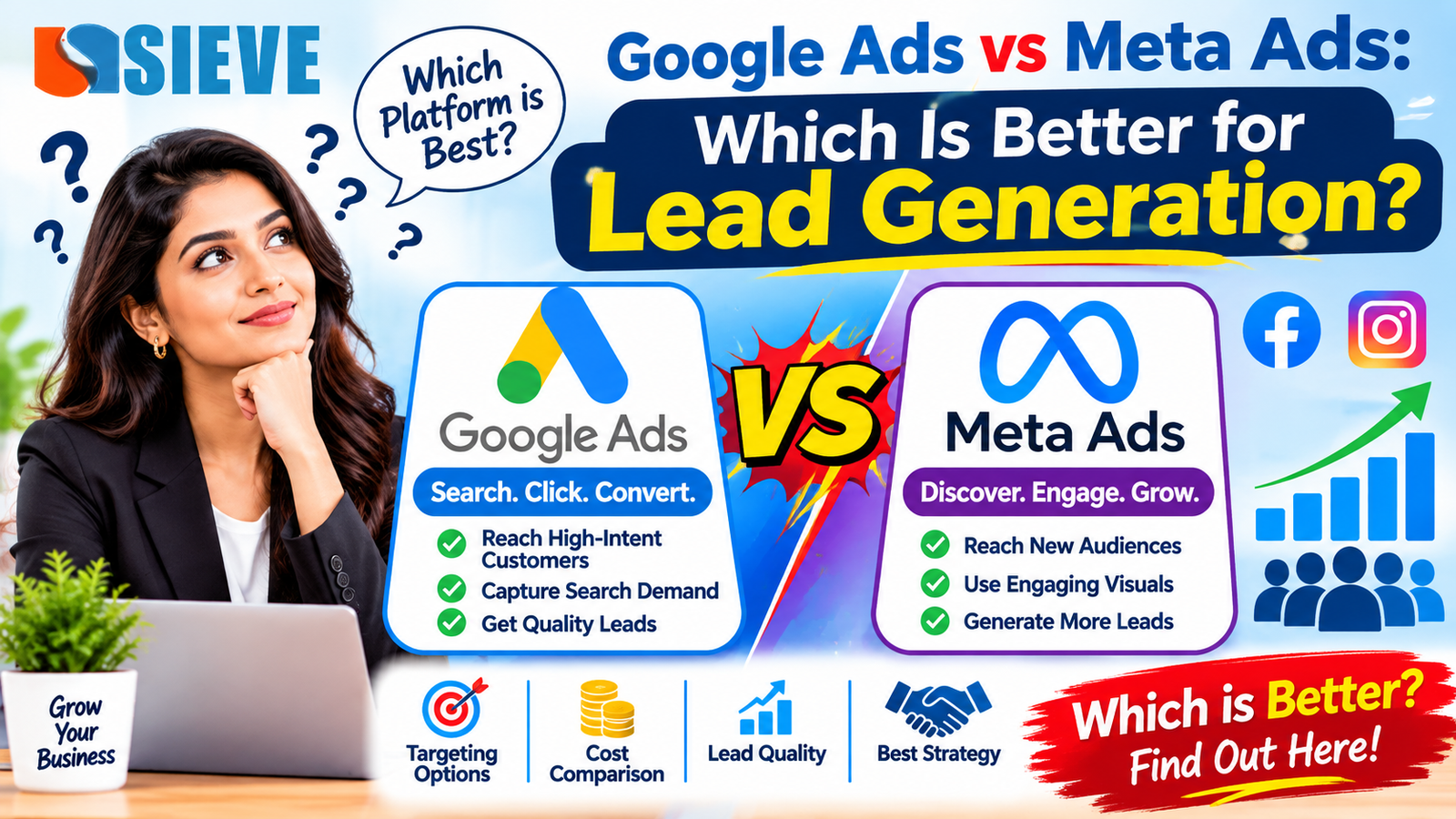
3. Google Ads vs Meta Ads: Key Differences
Both platforms can generate leads, but they approach customers differently.
| Comparison | Google Ads | Meta Ads |
|---|---|---|
| Main platforms | Google Search, YouTube and other Google placements | Facebook, Instagram and other Meta placements |
| Audience approach | Search intent and keywords | Audience signals and interests |
| Customer mindset | Often actively searching | Often browsing or discovering |
| Main strength | Capturing existing demand | Creating awareness and interest |
| Ad formats | Search, display, video and other formats | Images, videos, Reels and carousel ads |
| Lead generation | Website forms, calls and lead forms | Instant forms, website forms and messaging |
| Creative requirements | Relevant ad copy and landing pages | Attractive images, videos and offers |
| Best suited for | Search-driven services and products | Visual products and audience discovery |
The important difference is customer intent. Google can reach someone who is already looking for a solution, while Meta can introduce a business to someone who may be interested but has not started searching.
4. Advantages of Google Ads for Lead Generation
Google Ads can be an effective choice when customers actively search for your products or services.
A. Reach Customers With Search Intent
People searching for specific services often have an immediate requirement.
For example, someone searching for “SEO company in Hyderabad” may already be comparing agencies and looking for professional support.
This gives businesses an opportunity to reach potential customers at the right time.
B. Target Relevant Keywords
Google Search campaigns allow advertisers to select keywords related to their services.
Businesses can target relevant search terms and use negative keywords to reduce unwanted traffic.
For example, an agency offering professional SEO services may want to exclude irrelevant searches such as free SEO jobs or SEO training vacancies.
C. Generate Calls and Website Enquiries
Google Ads can direct potential customers to a website, phone call, or eligible lead form.
A well-designed landing page with clear service information and a contact form can help convert visitors into enquiries.
D. Measure Campaign Performance
Businesses can monitor clicks, impressions, conversions, cost per lead, and other performance indicators.
Conversion tracking helps identify which campaigns are generating meaningful business enquiries.
E. Suitable for Local Businesses
Local businesses can use location targeting to reach potential customers in their service areas.
For example, a company serving Hyderabad can create campaigns targeting relevant locations and searches for its services.
5. Advantages of Meta Ads for Lead Generation
Meta Ads are useful for businesses that want to reach potential customers before they actively search for a product or service.
A. Reach New Audiences
Meta allows businesses to reach people using audience signals such as location, interests, and engagement.
This can help companies introduce their products and services to new audiences.
B. Attractive Visual Advertisements
Facebook and Instagram support image, video, carousel, and short-form video advertisements.
Businesses can demonstrate products, explain services, and communicate offers through visual content.
For example, a real estate company can use property videos and photographs to attract people interested in residential projects.
C. Lead Forms Within the Platform
Meta Instant Forms allow potential customers to submit their contact information without necessarily visiting an external website.
Businesses can include qualifying questions to understand the customer’s requirements.
D. Click-to-WhatsApp Advertising
Businesses can use eligible Meta advertisements to start WhatsApp conversations with potential customers.
This is useful for businesses that handle enquiries and customer communication through WhatsApp.
E. Retargeting Opportunities
Businesses can create eligible audiences based on website visits, social media engagement, and other interactions.
Retargeting helps reconnect with people who previously showed interest but did not complete an enquiry.
6. Which Platform Generates Better Quality Leads?
Lead quality is one of the most important factors when comparing Google Ads and Meta Ads.
Google Search Ads often attract people with stronger immediate intent because they are actively searching for a solution.
Meta Ads may generate more initial enquiries at a lower cost in some campaigns, but some users may submit a form simply because it is convenient.
However, neither platform guarantees high-quality leads.
Lead quality depends on several factors:
- Target audience.
- Keyword or audience selection.
- Advertisement messaging.
- Landing page quality.
- Form questions.
- Service pricing.
- Customer requirements.
- Follow-up speed.
- Sales process.
Example:
A website development company runs two campaigns.
- Google Ads targets people searching for website development services.
- Meta Ads shows a website development offer to business owners browsing Instagram and Facebook.
The Google campaign may attract people who are already looking for a developer. The Meta campaign may introduce the service to business owners who have not yet decided to build a website.
Both campaigns can generate customers, but the sales process and lead qualification may differ.
7. Google Ads vs Meta Ads: Which Is More Cost-Effective?
Advertising cost depends on industry competition, audience, location, campaign settings, advertisement quality and conversion rates.
Google Search Ads can have higher costs for competitive keywords. Meta Ads may generate less expensive initial enquiries in some industries, but cheaper leads do not always become customers.
For this reason, businesses should not compare platforms only by cost per click or cost per lead.
Consider these measurements:
- Cost per lead (CPL).
- Cost per qualified lead.
- Lead-to-customer conversion rate.
- Cost per acquisition (CPA).
- Return on advertising spend (ROAS), where applicable.
Example:
Suppose a business spends ₹10,000 on each platform.
- Google Ads generates 20 leads.
- Meta Ads generates 40 leads.
At first glance, Meta appears to perform better because it generates more enquiries.
However, suppose only 12 Google leads and 8 Meta leads are qualified. The business must compare the cost of acquiring qualified leads and actual customers before deciding which platform performs better.
These numbers are illustrative, not industry benchmarks.
8. Which Businesses Should Choose Google Ads?
Google Ads may be the better starting point when people already search for your products or services.
It can work well for:
- Healthcare and clinic services.
- Legal and professional services.
- Digital marketing agencies.
- Website development companies.
- Home repair and maintenance.
- Education and training services.
- Business-to-business services.
- Local service providers.
For example, a company offering SEO services in Hyderabad can target relevant search queries from people actively looking for an SEO agency.
9. Which Businesses Should Choose Meta Ads?
Meta Ads can be a strong option when businesses need to create awareness, demonstrate products, or reach audiences based on their interests.
It can work well for:
- Fashion and clothing brands.
- Restaurants and food businesses.
- Beauty and lifestyle products.
- Real estate projects.
- Educational programmes.
- Events and entertainment.
- E-commerce businesses.
- New product launches.
For example, a clothing brand can use Instagram Reels advertisements to showcase new collections and encourage people to visit its online store.
10. Can Businesses Use Google Ads and Meta Ads Together?
Yes. Using both platforms can create a more complete digital marketing strategy.
Google Ads can capture people who are actively searching for a product or service, while Meta Ads can build awareness, introduce offers, and reconnect with interested audiences.
A practical combined strategy:
- Use Google Search Ads to target high-intent keywords.
- Use Meta Ads to introduce your business to relevant new audiences.
- Retarget eligible website visitors and social media audiences.
- Create dedicated landing pages for different campaigns.
- Track enquiries and qualified leads from both platforms.
- Review actual customer acquisition costs before increasing budgets.
For example, a Hyderabad-based digital marketing agency can use Google Ads to reach businesses searching for SEO services and Meta Ads to promote educational videos about online marketing.
Both platforms can support different stages of the customer’s decision-making process.
11. How to Improve Lead Generation Results on Both Platforms
Running advertisements is only one part of successful lead generation. Businesses also need a proper strategy to convert enquiries into customers.
Step 1: Define Your Target Audience
Identify your ideal customers, their location, requirements, and problems.
Step 2: Create a Clear Advertising Message
Explain what your business offers and why potential customers should contact you.
Step 3: Use Relevant Landing Pages
Make sure the advertisement leads to a page that matches the advertised product or service.
Step 4: Add Simple Enquiry Forms
Ask for essential information such as name, phone number, email, and service requirement. Use additional questions only when they help qualify leads.
Step 5: Set Up Conversion Tracking
Track important actions such as calls, form submissions, bookings, and qualified enquiries.
Step 6: Follow Up Quickly
Contact new leads promptly and record their progress in a CRM or lead management system.
Step 7: Review Performance Regularly
Identify which campaigns generate qualified leads and actual customers. Adjust budgets based on performance.
12. Common Mistakes to Avoid in Paid Advertising
Businesses can waste advertising budgets when campaigns are poorly planned or measured.
Avoid these common mistakes:
- Running campaigns without clear goals.
- Targeting audiences that are too broad or irrelevant.
- Using unrelated keywords.
- Sending every advertisement to the homepage.
- Creating advertisements without a clear call to action.
- Ignoring mobile users.
- Not tracking conversions.
- Failing to follow up with enquiries.
- Judging performance only by clicks or impressions.
- Increasing the budget before understanding campaign quality.
A successful advertising strategy requires regular monitoring, testing, and improvement.
13. Final Verdict: Google Ads vs Meta Ads – Which Is Better for Lead Generation?
There is no single winner for every business. The right platform depends on how customers discover and choose your products or services.
Choose Google Ads if:
- Customers actively search for your services.
- You want to capture high-intent enquiries.
- Your business provides urgent or specialised services.
- You have relevant landing pages and conversion tracking.
Choose Meta Ads if:
- You want to build brand awareness.
- Your product or service is visually appealing.
- You want to reach new audiences.
- You need social media engagement or WhatsApp enquiries.
Choose both if:
- You have sufficient budget and resources.
- You want to generate demand and capture existing demand.
- You can track leads and sales across both platforms.
The best platform is the one that brings qualified leads and customers at a sustainable cost.
Conclusion
Google Ads and Meta Ads are both powerful tools for lead generation, but they serve different purposes.
Google Ads helps businesses connect with people actively searching for products and services. Meta Ads helps businesses discover new audiences through Facebook and Instagram advertising.
Instead of choosing a platform only because it offers cheaper clicks or more enquiries, focus on lead quality, conversions, and customer acquisition costs.
A well-planned strategy, relevant advertisements, strong landing pages, and consistent follow-up can improve results from either platform.
At SIEVES OF TECH, we help businesses strengthen their online presence through digital marketing, SEO, Google Ads, social media marketing and website development.
Choose the right advertising strategy and turn your marketing investment into meaningful business opportunities.
Frequently Asked Questions
1. Which is better for lead generation: Google Ads or Meta Ads?
Google Ads is often better when customers actively search for your services. Meta Ads is useful for reaching new audiences, creating awareness, and generating enquiries through Facebook and Instagram.
2. Are Google Ads more expensive than Meta Ads?
Costs vary by industry, audience, competition, and campaign settings. Google Search keywords can be expensive in competitive markets, while Meta may generate lower-cost initial leads in some campaigns.
3. Which platform gives better-quality leads?
Google Search Ads often attract higher-intent enquiries. However, both platforms can generate quality leads when targeting, advertising messages, forms, and follow-up processes are properly managed.
4. Are Meta Ads suitable for small businesses?
Yes. Meta Ads can help small businesses promote products, reach local audiences, build awareness and generate enquiries through Facebook and Instagram.
5. Can I run Google Ads and Meta Ads at the same time?
Yes. Businesses can use Google Ads to capture existing search demand and Meta Ads to build awareness, reach new audiences and retarget interested users.
6. What is the minimum budget for Google Ads and Meta Ads?
There is no single minimum budget suitable for every business. The budget should depend on your industry, location, competition, target audience, and expected cost per qualified lead.
7. How long does it take to generate leads from paid advertising?
Campaigns can start receiving enquiries soon after approval and launch, but consistent performance requires testing, conversion tracking and optimisation.
8. What is the difference between Google Search Ads and Instagram Ads?
Google Search Ads appear in response to relevant search queries. Instagram Ads appear in placements such as feeds, Stories and Reels based on advertising delivery and audience signals.
9. How can I improve lead quality from Meta Ads?
Use relevant creatives, clear offers, qualifying form questions, higher-intent form options where available, and timely follow-up. Connect lead outcomes to your CRM and campaign measurement where supported.
10. How do I measure the success of a lead generation campaign?
Track cost per qualified lead, conversion rate, customer acquisition cost, booked appointments, and sales. Do not judge campaign success only by clicks or the number of form submissions.