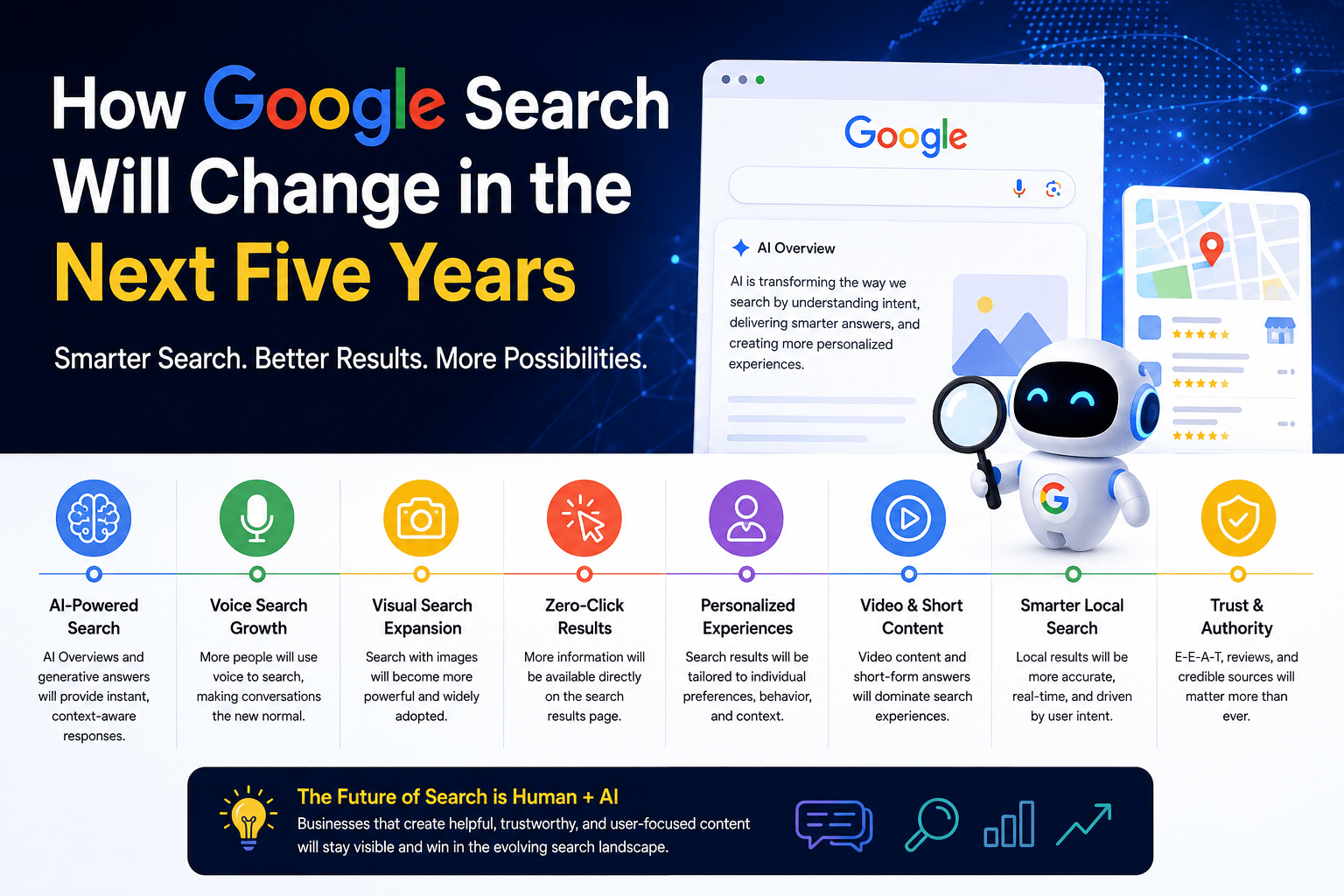
how Google Search will evolve over the next five years with AI-powered search, AI Overviews, voice search, visual search, personalized search results, local SEO, and smarter search experiences.
July 23, 2026

How Google Search Will Change in the Next Five Years: What Businesses Must Know to Stay Ahead

Google Search has been evolving for more than two decades, transforming from a simple keyword-based search engine into an intelligent platform that understands context, intent, images, videos, voice, and even conversations. With the rapid advancement of artificial intelligence (AI), machine learning, and user behavior, the next five years will bring even more significant changes.

Businesses that rely on organic traffic can no longer depend solely on traditional SEO techniques such as keyword stuffing or link building. Google’s future is focused on delivering the most helpful, trustworthy, and personalized information to users in the fastest possible way.

Whether you’re a business owner, marketer, blogger, or SEO professional, understanding these upcoming changes will help you prepare your website for long-term success.

In this guide, we’ll explore the biggest trends shaping the future of Google Search and explain how businesses can adapt to remain visible in an increasingly AI-driven digital landscape.


Why Google Search Continues to Evolve

Google processes billions of searches every day. As user expectations change, Google continuously improves its search algorithms to provide more accurate, relevant, and personalized results.

Today’s users expect:

  • Instant answers
  • Personalized recommendations
  • Voice-based searches
  • AI-generated summaries
  • Visual search capabilities
  • Local business recommendations
  • Secure and trustworthy websites

To meet these expectations, Google invests heavily in AI technologies, natural language processing, and user experience improvements.


1. AI Will Become the Center of Google Search

Artificial Intelligence is already transforming how Google understands search queries. Over the next five years, AI will become even more integrated into every aspect of search.

Instead of simply matching keywords, Google will better understand:

  • User intent
  • Context
  • Search history
  • Conversation flow
  • Follow-up questions
  • Content quality

AI-powered search experiences will provide users with comprehensive answers rather than just lists of web pages.

For businesses, this means creating content that genuinely solves user problems instead of focusing only on ranking for keywords.


2. AI Overviews Will Dominate Search Results

Google is increasingly displaying AI-generated summaries at the top of search results. These AI Overviews provide users with quick, synthesized answers from multiple trusted sources.

In the coming years:

  • More searches will show AI-generated responses.
  • Users may get answers without clicking on websites.
  • High-quality, authoritative content will be more likely to be referenced.

To improve your chances of being featured, create content that is well-structured, factual, and demonstrates expertise.


3. Search Will Become More Conversational

People are moving away from short keyword phrases and using natural language queries.

Instead of searching:

  • “best SEO company”

Users now ask:

  • “Which SEO company is best for small businesses in Hyderabad?”

Google’s AI can understand conversational queries and provide more precise results.

Content should answer complete questions in a natural, easy-to-read format.


4. Voice Search Will Continue to Grow

Smartphones, smart speakers, and AI assistants have made voice search a regular part of daily life.

Users commonly ask:

  • “Where is the nearest coffee shop?”
  • “What’s the best laptop under ₹70,000?”
  • “How do I recover my Google Business Profile?”

Voice searches tend to be longer and more conversational than typed queries.

To optimize for voice search:

  • Use natural language.
  • Include FAQ sections.
  • Target long-tail keywords.
  • Optimize for featured snippets.

5. Visual Search Will Become Mainstream

Google Lens has already changed how people search using images instead of text.

In the future, users will increasingly:

  • Photograph products to find similar items.
  • Scan landmarks for information.
  • Search using screenshots.
  • Identify plants, animals, or objects instantly.

Businesses should optimize:

  • Image quality
  • File names
  • ALT text
  • Structured image data

Visual SEO will become just as important as traditional SEO.


6. Video Content Will Rank Even Higher

Google continues to prioritize engaging video content, especially for tutorials, product demonstrations, and educational topics.

Businesses should create:

  • YouTube videos
  • Short-form educational videos
  • Product walkthroughs
  • Customer testimonials
  • Explainer videos

Embedding videos within blog posts can improve engagement and increase time spent on your website.


7. User Experience Will Influence Rankings More

Google rewards websites that provide excellent user experiences.

Key ranking factors include:

  • Fast page speed
  • Mobile responsiveness
  • Easy navigation
  • Secure HTTPS connections
  • Accessible design
  • Minimal intrusive ads

A positive user experience encourages visitors to stay longer and interact with your content, signaling quality to Google.


8. E-E-A-T Will Become Even More Important

Google’s emphasis on Experience, Expertise, Authoritativeness, and Trustworthiness (E-E-A-T) will continue to grow.

To build trust:

  • Publish original content.
  • Cite reliable sources.
  • Showcase author credentials.
  • Keep information up to date.
  • Display customer reviews and testimonials.

Websites that demonstrate real expertise are more likely to earn visibility in AI-driven search results.


9. Local Search Will Become Smarter

Local businesses will benefit from more personalized search experiences.

Google will increasingly consider:

  • User location
  • Search history
  • Real-time business information
  • Customer reviews
  • Business activity
  • Photos and updates

Keeping your Google Business Profile complete and active will remain essential for local visibility.


10. Personalization Will Increase

Google will continue tailoring search results based on individual preferences.

Factors influencing results may include:

  • Previous searches
  • Device type
  • Location
  • Interests
  • Language
  • Search behavior

This means businesses should focus on creating content for specific audiences rather than trying to rank for everyone.11. Zero-Click Searches Will Continue to Increase

One of the biggest changes in Google Search is the rise of zero-click searches. These occur when users find the information they need directly on the search results page without visiting a website.

Examples include:

  • AI Overviews
  • Featured Snippets
  • Knowledge Panels
  • Local Business Profiles
  • Weather forecasts
  • Sports scores
  • Currency conversions
  • Definitions

While this may reduce clicks for some queries, it creates new opportunities for businesses that produce authoritative, well-structured content. The goal should no longer be to rank first alone—it should be to become the source Google trusts enough to feature.


12. Search Intent Will Matter More Than Keywords

Traditional SEO focused heavily on exact-match keywords. Over the next five years, Google will continue shifting toward understanding why a user is searching rather than simply matching words.

The four main search intents are:

Informational

Users want to learn something.

Example:

  • What is Local SEO?

Navigational

Users are looking for a specific website.

Example:

  • Google Business Profile login

Commercial Investigation

Users are comparing products or services.

Example:

  • Best CRM software for small businesses

Transactional

Users are ready to make a purchase.

Example:

  • Buy wireless headphones online

Businesses that create content matching each stage of the customer journey will perform better than those targeting keywords alone.


13. Helpful Content Will Continue to Win

Google’s Helpful Content System rewards content created for people, not just search engines.

Successful content will:

  • Answer real questions.
  • Solve specific problems.
  • Include practical examples.
  • Be easy to read.
  • Stay accurate and updated.
  • Demonstrate first-hand knowledge where possible.

Instead of publishing dozens of short articles, businesses should focus on comprehensive, high-quality resources that genuinely help readers.


14. Topical Authority Will Become a Major Ranking Factor

Rather than ranking isolated pages, Google increasingly evaluates whether a website demonstrates expertise across an entire subject.

For example, a digital marketing agency should publish content on:

  • SEO
  • Local SEO
  • Google Business Profile
  • Content Marketing
  • PPC Advertising
  • Technical SEO
  • AI in Marketing
  • Social Media Marketing
  • Analytics
  • Website Optimization

A library of related, interconnected content helps establish your website as a trusted authority.


15. Structured Data Will Become More Important

Structured data helps Google understand your content and display rich search results.

Useful schema types include:

  • FAQ Schema
  • Article Schema
  • Local Business Schema
  • Product Schema
  • Review Schema
  • Event Schema
  • Organization Schema

Implementing structured data improves your chances of appearing in rich results and AI-generated search experiences.


16. Trust Signals Will Influence Rankings

Google aims to surface reliable information. Websites that build trust are more likely to perform well.

Important trust signals include:

  • Secure HTTPS website
  • Accurate contact information
  • Privacy Policy
  • Terms and Conditions
  • Genuine customer reviews
  • Clear author information
  • Updated content
  • Consistent branding

Trust is becoming a competitive advantage in search.


17. Mobile-First Will Become Mobile-Only

Since most searches happen on smartphones, mobile optimization is essential.

Your website should offer:

  • Fast loading times
  • Responsive layouts
  • Readable text
  • Easy navigation
  • Click-friendly buttons
  • Optimized images

A poor mobile experience can negatively affect both user satisfaction and search performance.


18. AI Tools Will Support SEO—Not Replace It

AI is transforming how marketers research, write, and optimize content. It can help with:

  • Content ideas
  • Keyword research
  • Draft creation
  • Meta descriptions
  • Content optimization
  • Performance analysis

However, AI-generated content should always be reviewed and enhanced with human expertise, original insights, and accurate information. Businesses that combine AI efficiency with human quality will have a significant advantage.


How Businesses Should Prepare for the Future of Google Search

To stay competitive over the next five years, businesses should:

  • Publish helpful, original, and regularly updated content.
  • Focus on user intent instead of keyword density.
  • Strengthen E-E-A-T by demonstrating expertise and credibility.
  • Optimize for AI Overviews, voice search, and visual search.
  • Improve page speed and overall user experience.
  • Maintain an optimized Google Business Profile.
  • Build topical authority through comprehensive content clusters.
  • Use structured data where appropriate.
  • Earn high-quality backlinks through valuable resources.
  • Monitor SEO performance and adapt to algorithm updates.

Businesses that embrace these strategies will be better positioned to maintain visibility as Google Search continues to evolve.


Frequently Asked Questions

Will AI replace traditional Google Search?

AI will significantly enhance Google Search by providing conversational answers and summaries, but websites will continue to play a critical role as sources of original, trustworthy information.


Is SEO still worth investing in?

Yes. SEO remains one of the most cost-effective digital marketing strategies. While tactics will evolve, businesses that create valuable, user-focused content will continue to benefit from organic search traffic.


How important is Google Business Profile in the future?

Google Business Profile will remain a key factor for local businesses. Accurate information, customer reviews, and regular updates help improve visibility in Google Search and Google Maps.


Will keywords still matter?

Yes, but their role is changing. Keywords help Google understand topics, while search intent, content quality, and context play a much larger role in determining rankings.


How often should I update my content?

Review important pages at least every 6–12 months. Update statistics, examples, screenshots, and outdated information to keep content relevant and useful.


Conclusion

The next five years will reshape Google Search more than the previous decade. Artificial intelligence, conversational search, AI Overviews, voice search, visual search, and personalized experiences are changing how users discover information online. Success will depend less on traditional SEO tricks and more on delivering genuine value, demonstrating expertise, and creating content that answers users’ questions clearly and accurately.

Businesses that adapt early will gain a competitive advantage. By investing in high-quality content, optimizing for emerging search experiences, improving user experience, and building trust with both users and search engines, organizations can continue to grow their organic visibility despite rapid technological changes.

The future of Google Search isn’t about chasing algorithms—it’s about understanding people. Companies that consistently publish helpful, reliable, and engaging content will be best positioned to thrive in the AI-powered search landscape of the years ahead.

Categories: Blog

Leave a Comment