The Future of Google Maps Marketing: Trends, AI, and Local SEO in 2026 and Beyond
Introduction
Google Maps has become much more than a navigation tool. For local businesses, it is now a major discovery platform where customers search for services, compare businesses, read reviews, check photos, find opening hours, and decide where to spend their money.
The next stage of Google Maps marketing is already taking shape. Artificial intelligence, conversational search, personalized recommendations, reviews, visual content, and business data are changing how customers discover local businesses.
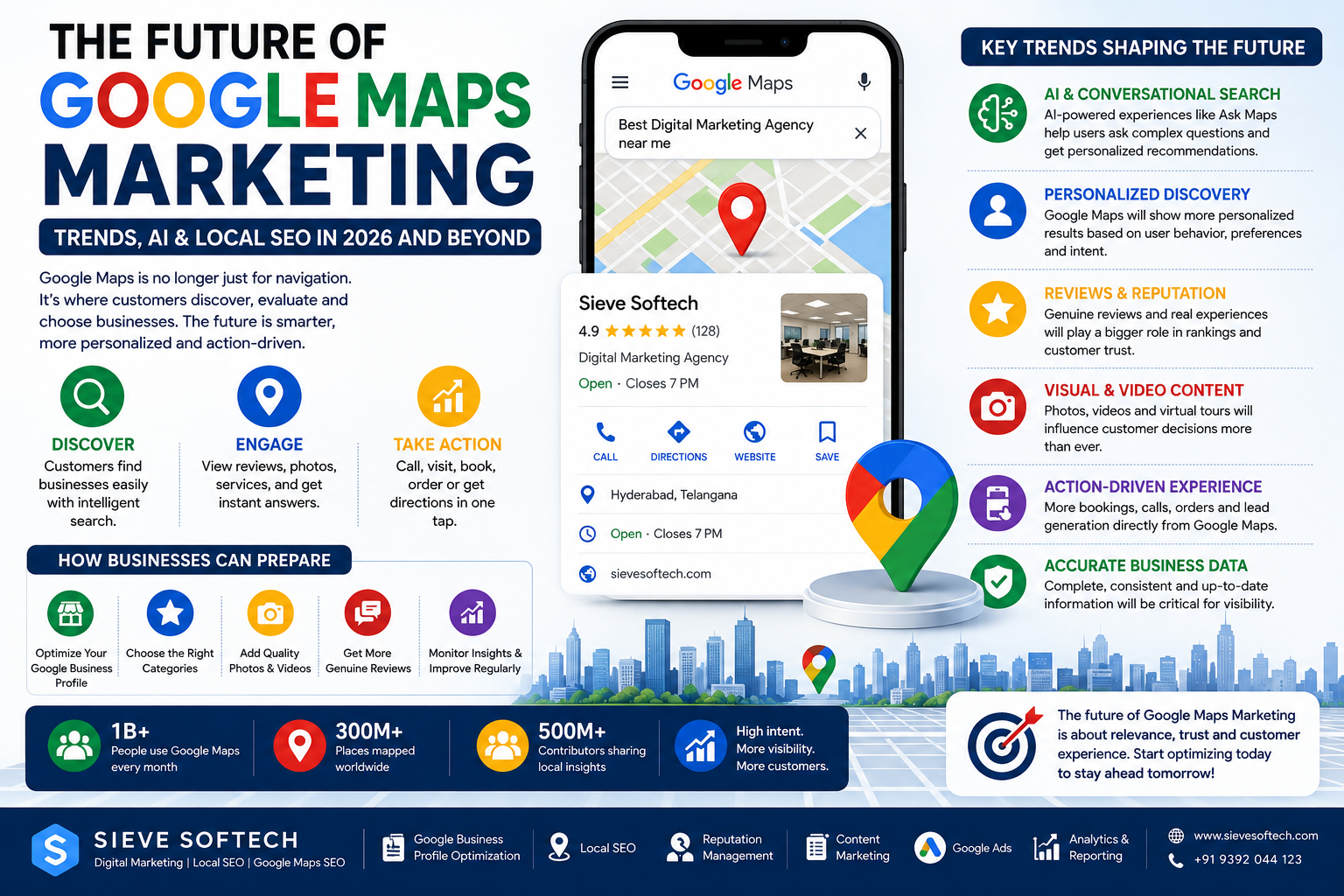
In March 2026, Google introduced Ask Maps, a Gemini-powered conversational experience that allows users to ask complex questions about places and receive personalized recommendations. Google says Ask Maps uses information from more than 300 million places and insights from its Maps community of more than 500 million contributors globally. The feature began rolling out in the U.S. and India on Android and iOS.
This means the future of Google Maps marketing will not simply be about ranking for searches such as “best restaurant near me.” Businesses will increasingly need to provide enough accurate, useful, and trustworthy information for Google’s systems to understand what they offer and when they are relevant to a customer’s needs.
In this guide, we’ll explore the biggest Google Maps marketing trends, how AI is changing local discovery, and what businesses can do now to prepare for the future.
What Is Google Maps Marketing?
Google Maps marketing is the process of improving a business’s visibility when customers search for local businesses through Google Maps and Google Search.
It usually involves optimizing a Google Business Profile, improving local SEO, earning genuine reviews, maintaining accurate business information, creating useful content, and building a strong online reputation.
For example, a customer might search:
- “Best digital marketing agency near me”
- “Dentist in Hyderabad”
- “Restaurants near Kukatpally”
- “Hair salon near me”
- “International courier service in Hyderabad”
Google evaluates local businesses and displays the results it believes are most relevant to the search.
Google states that local results are primarily influenced by relevance, distance, and prominence. Complete business information, reviews, links, and other signals can contribute to local visibility.
Why Google Maps Marketing Is Becoming More Important
Local customers often have strong purchase intent.
Someone searching for a nearby restaurant, clinic, salon, courier company, or service provider may already be looking for a business they can contact or visit.
Google Maps can help customers:
- Discover businesses
- Compare ratings
- Read reviews
- View photos
- Check opening hours
- Visit a website
- Call a business
- Get directions
- Make bookings where available
This makes Maps marketing particularly valuable for businesses that depend on local customers.
The future will make this experience even more intelligent.
1. AI Will Transform Local Search
Artificial intelligence is becoming one of the biggest forces shaping Google Maps.
Google’s integration of Gemini into Maps allows users to ask conversational questions rather than relying only on traditional keyword searches. For example, instead of searching for a list of restaurants, a customer could ask for a place that matches several preferences at once.
This changes the way businesses should think about Local SEO.
Instead of optimizing only for:
“Restaurant Hyderabad”
businesses should provide information that helps answer more detailed questions about their services, products, location, amenities, and customer experience.
What Businesses Should Do
Make your Business Profile as informative as possible.
Include accurate:
- Business category
- Services
- Products
- Hours
- Address
- Contact details
- Photos
- Website information
- Attributes
The more useful information Google has, the easier it can be to understand your business.
2. Conversational Search Will Change Local SEO
Traditional searches are often short:
“Best salon near me”
Conversational searches can be much more detailed:
“Which salon near me has good reviews, parking, and appointments available this evening?”
AI-powered search can interpret multiple requirements within one request.
This means businesses need to think beyond individual keywords.
Your content should naturally answer questions customers may ask about your business.
For example, a salon could provide information about:
- Services
- Price ranges
- Appointment options
- Parking
- Opening hours
- Hair specialists
- Products
- Customer experiences
This creates a richer information profile for both customers and search systems.
3. Google Maps Will Become More Personalized
Google is moving toward more personalized recommendations.
Google Maps can use information such as places a user has searched for or saved to make recommendations more relevant to that individual.
This means there may not be one universal “best business” for every customer.
A business may be highly relevant to one customer because of its services, reviews, location, or preferences, while another customer may receive a different recommendation.
The Opportunity
Businesses should build strong, complete profiles rather than trying to optimize for one keyword alone.
The goal is to become a highly relevant option for the right audience.
4. Reviews Will Become Even More Important
Reviews are already a major part of local discovery.
Customers use them to evaluate:
- Quality
- Service
- Reliability
- Pricing
- Customer support
- Overall experience
Google also says reviews and positive ratings can contribute to local ranking.
The future of review marketing will likely focus increasingly on authenticity and context.
Google is also investing in systems to combat fake reviews and scams. In April 2026, Google announced new protections for businesses on Maps and said its systems were being upgraded to stop new types of review scams and fake-review activity.
Best Practice
Don’t buy reviews.
Instead:
- Deliver excellent service.
- Ask genuine customers for honest feedback.
- Make the review process simple.
- Respond professionally.
- Monitor suspicious activity.
A strong reputation built on real experiences is much more sustainable.
5. Visual Search Will Become More Powerful
Customers increasingly use images as part of discovery.
Google Maps already incorporates photos and visual information into the local experience, while AI makes it easier to understand different types of content.
Businesses should therefore treat photos as an important part of their Maps strategy.
Upload authentic images showing:
- Storefront
- Office
- Products
- Team members
- Interior
- Equipment
- Services
- Completed projects
Avoid relying entirely on generic stock photographs.
Real images help customers understand what they can expect when they visit your business.
6. Video Will Play a Bigger Role
Video can communicate information much faster than text.
Businesses can use short videos to demonstrate:
- Products
- Services
- Facilities
- Customer experiences
- Before-and-after results
- Tutorials
- Business locations
For example, a hotel could show its rooms and facilities, while a restaurant could showcase its food and dining environment.
Video content can also support your broader Google Search, YouTube, and social media strategy.
7. Accurate Business Data Will Become Critical
AI systems depend on reliable information.
If your Business Profile says your business closes at 6 PM, but your website says 8 PM, customers may receive confusing information.
Keep these details consistent:
- Business name
- Address
- Phone number
- Website
- Opening hours
- Holiday hours
- Services
- Categories
- Booking information
Google specifically recommends keeping Business Profile information complete and accurate to improve local visibility and help customers understand what the business does and when they can visit.
8. Business Categories Will Matter More
Categories help Google understand what a business is.
Google explains that categories connect businesses with searches for their products and services and that selected categories can affect local ranking.
For example, a business should choose the most specific category that accurately represents its primary operation.
Don’t select unrelated categories simply because they contain popular keywords.
Future Strategy
Review your categories regularly and make sure they still accurately represent your business.
However, don’t change them constantly without a legitimate reason.
9. Google Maps Will Become More Transactional
The future of local search is moving beyond discovery.
Customers increasingly want to take action directly from search and Maps.
Depending on the business, that action might include:
- Calling
- Booking
- Ordering
- Requesting information
- Getting directions
- Checking products
- Saving a location
Google’s newer AI experiences are designed to help users move from questions to actions, including bookings and navigation from Maps.
Businesses should therefore make their profiles easy to act on.
10. Local Search and AI Search Will Converge
SEO used to focus heavily on ranking a webpage.
Local SEO focused heavily on ranking a Business Profile.
The future is more connected.
A customer’s journey might look like:
Google Search → AI answer → Google Maps → Business Profile → Website → Call/Booking
This means businesses need a consistent digital presence across all these touchpoints.
Your website should support your Business Profile rather than contradict it.
11. Local Content Will Become More Valuable
Businesses should create useful content based on the questions their local customers actually ask.
For example, a digital marketing agency could publish:
- Local SEO Guide for Hyderabad Businesses
- How Google Maps Ranking Works
- How to Optimize a Google Business Profile
- How to Get More Genuine Google Reviews
A healthcare business could create:
- When Should You See a Specialist?
- Common Questions About a Medical Procedure
- How to Choose a Clinic in Your Area
The objective isn’t to create pages stuffed with city names.
The goal is to demonstrate genuine knowledge and local relevance.
12. Reputation Management Will Become a Core Marketing Function
In the past, reputation management was sometimes treated as a separate activity.
In the future, it will become closely connected with Local SEO and customer acquisition.
Businesses will need to monitor:
- Reviews
- Ratings
- Customer comments
- Business information
- Photos
- Mentions
- Competitor activity
- Fake reviews
A strong reputation can influence whether a customer chooses your business after discovering it on Maps.
13. AI Will Help Businesses Manage Local Marketing
AI isn’t only changing how customers search. It’s also changing how marketers manage campaigns.
Google has introduced Gemini-powered tools for businesses, including a direct Google Business Profile connection in the Gemini app and features designed to help businesses work with their own brand and customer information.
Google is also introducing AI tools for marketers, including Ask Advisor, which connects marketing data and provides recommendations across Google’s marketing products.
This suggests that businesses will increasingly use AI to:
- Analyze performance
- Identify opportunities
- Create content
- Monitor trends
- Improve campaigns
- Understand customers
- Automate repetitive marketing tasks
Human strategy will still matter, but AI can speed up execution.
14. Google Maps Advertising Will Become Smarter
Paid and organic local marketing are likely to become increasingly connected.
Google is developing AI-powered advertising experiences that use Gemini to make ads more conversational and relevant. At Google Marketing Live 2026, Google announced new AI-driven ad formats and tools for Search.
For local businesses, this means advertising may become more closely connected to customer intent.
Instead of simply showing an advertisement, future experiences may help customers discover a business, understand its offer, and take action within the same journey.
15. Local Businesses Need First-Party Information
Businesses should make their own websites and profiles reliable sources of information.
Maintain clear information about:
- Services
- Products
- Locations
- Prices where appropriate
- Hours
- Contact details
- Frequently asked questions
- Policies
This gives customers and search systems a stronger understanding of your business.
How to Prepare Your Business for the Future of Google Maps Marketing
A future-ready strategy should include the following:
1. Fully Optimize Your Google Business Profile
Complete every relevant section.
2. Choose Accurate Categories
Use the most specific category that genuinely describes your business.
3. Build Genuine Reviews
Focus on customer satisfaction rather than review manipulation.
4. Add Fresh Photos and Videos
Show customers what your business actually looks like.
5. Keep Information Accurate
Update hours, services, contact information, and other details regularly.
6. Strengthen Your Website
Create useful service and location content that supports your Business Profile.
7. Create Helpful Local Content
Answer real questions from your target customers.
8. Monitor Performance
Track calls, website visits, direction requests, searches, reviews, and other available Business Profile insights.
9. Use AI Carefully
Use AI to improve productivity, research, analysis, and content workflows while maintaining human review and accuracy.
10. Focus on Customer Experience
The strongest long-term Maps strategy is still simple: give customers a reason to choose your business and recommend it to others.
How Sieve Softech Can Help
The future of Google Maps marketing requires more than basic profile setup. Businesses need a connected Local SEO strategy that combines Google Business Profile optimization, content, reviews, website SEO, reputation management, and performance tracking.
Sieve Softech can help businesses build this foundation through services such as:
- Google Business Profile Optimization
- Google Maps SEO
- Local SEO
- Google Business Profile Category Optimization
- Review and Reputation Management
- Local Citation Management
- Technical SEO
- Keyword Research
- Content Marketing
- Website SEO
- Google Ads
- Social Media Marketing
Our approach focuses on building accurate, useful, and trustworthy digital assets rather than relying on shortcuts.
Whether you’re a local retailer, restaurant, healthcare provider, educational institution, professional services business, or growing company, a strong Maps strategy can help you connect with customers when they are looking for what you offer.
Frequently Asked Questions
Will Google Maps still be important as AI search grows?
Yes. Google’s current direction suggests that Maps is becoming more deeply integrated with AI rather than becoming less important. Ask Maps is an example of how Google is combining conversational AI with location-based information.
Will keywords become less important in Google Maps marketing?
Keyword relevance will still matter, but businesses should focus less on stuffing keywords and more on accurately describing their business, services, products, and customer experience.
Are Google reviews still important?
Yes. Reviews help customers evaluate businesses, and Google says review quantity and positive ratings can contribute to local ranking.
Should every business use AI for Google Maps marketing?
AI can help with research, content, analysis, and workflow automation, but businesses should review AI-generated information carefully and prioritize accuracy.
Can a business guarantee the #1 position on Google Maps?
No. Google says there is no way to request or pay for a better local ranking. Local results are primarily based on relevance, distance, and prominence.
Conclusion
The future of Google Maps marketing is becoming more intelligent, conversational, visual, and personalized.
Customers will increasingly ask complex questions instead of typing simple keywords. AI will help Google understand those questions and connect users with businesses that best match their needs.
For businesses, this creates a new opportunity.
Instead of focusing only on ranking for one keyword, build a complete and trustworthy digital presence. Keep your Google Business Profile accurate. Choose the right category. Publish useful information. Collect genuine reviews. Add authentic photos and videos. Strengthen your website. Create helpful local content. And make it easy for customers to call, book, visit, or contact you.
Google Maps is moving from a simple map-based directory toward an AI-powered local discovery and action platform. Businesses that start preparing now will be better positioned to benefit as these experiences continue to evolve.
If you need help with Google Business Profile optimization, Google Maps SEO, Local SEO, reputation management, or digital marketing, Sieve Softech can help you build a strategy designed for the next generation of local search.