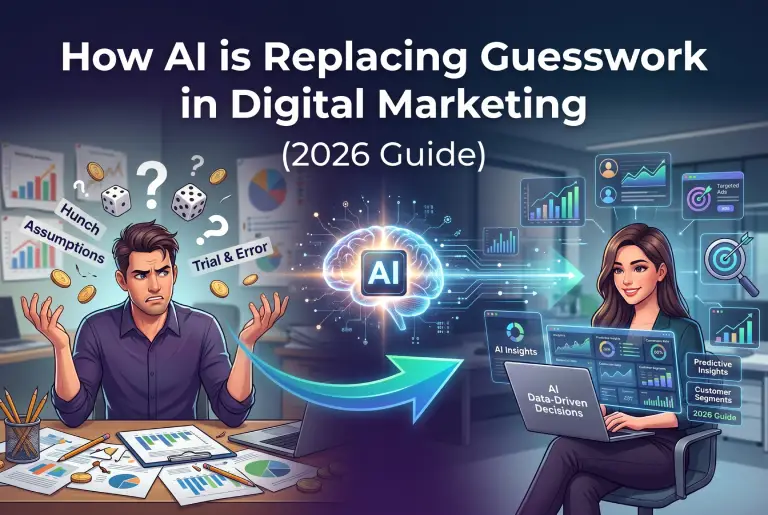
In the rapidly evolving landscape of digital marketing, relying on intuition and guesswork has historically been a significant challenge. Marketers often had to make educated guesses about audience behavior, campaign effectiveness, and content preferences without concrete data. However, as we move into 2026, artificial intelligence (AI) is fundamentally transforming this paradigm by replacing guesswork with data-driven precision. This comprehensive guide explores how AI is revolutionizing digital marketing strategies, enabling brands to achieve unprecedented levels of accuracy and efficiency. – AI is Replacing Guesswork in Digital Marketing in 2026
The Rise of Data-Driven Decision Making in Digital Marketing
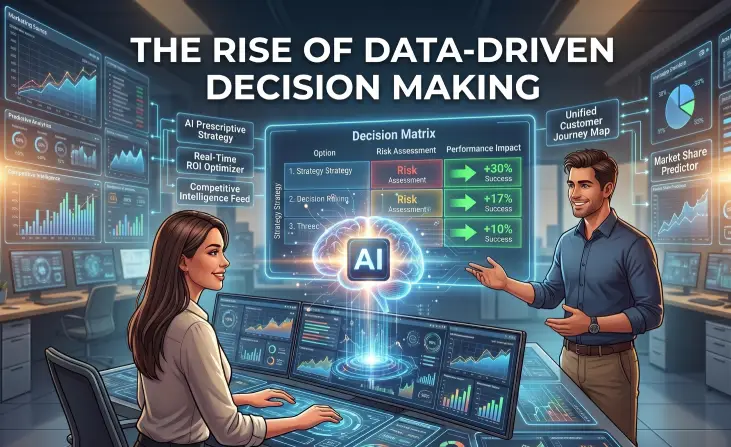
AI’s influence on digital marketing begins with its ability to facilitate data-driven decision making. Traditional marketing relied heavily on gut feelings and historical trends, which often led to inconsistent results. Today, AI systems analyze vast amounts of real-time data—such as user interactions, purchase history, and social media activity—to generate actionable insights. These insights allow marketers to craft highly targeted campaigns tailored to specific consumer segments. As a result, businesses can optimize their marketing spend and improve ROI more effectively than ever before. The shift towards data-driven strategies signifies a move away from subjective guesses toward objective analysis rooted in AI-powered analytics.
- Examples include:
- Predictive analytics forecasting customer lifetime value
- Real-time personalization based on browsing behavior
- Automated A/B testing driven by AI algorithms
This transformation empowers marketers with precise information rather than relying solely on assumptions, leading to smarter campaign planning and execution. – AI is Replacing Guesswork in Digital Marketing in 2026
Enhanced Customer Segmentation Through Machine Learning
One of the most impactful ways AI replaces guesswork is through advanced customer segmentation enabled by machine learning. Previously, segmentation was often based on broad demographics or limited behavioral data—an approach that lacked nuance. With AI, businesses can now analyze complex datasets to identify micro-segments with distinct preferences and needs. Machine learning models continuously learn from new data inputs, refining these segments over time for even greater accuracy. This granular segmentation allows for hyper-personalized messaging that resonates deeply with individual consumers. Consequently, marketers no longer need to guess what each segment wants; instead, they are equipped with precise profiles derived from AI analysis.
- Specific examples include:
- Segmenting users based on predictive purchasing patterns
- Identifying emerging niche markets through trend analysis
- Tailoring content recommendations dynamically for each user
By leveraging AI-driven segmentation, companies can deliver targeted experiences that significantly boost engagement and conversion rates.
Predictive Analytics and Campaign Optimization
AI’s predictive capabilities are transforming how campaigns are planned and optimized in digital marketing. Instead of launching campaigns based on assumptions about audience response, marketers utilize predictive models trained on historical data to forecast outcomes accurately. These models can predict click-through rates, conversion probabilities, and customer churn with remarkable precision. Consequently, campaign parameters such as timing, messaging, and channel allocation are fine-tuned for maximum effectiveness before launch. Additionally, real-time monitoring powered by AI allows for continuous adjustments during a campaign’s lifecycle, ensuring optimal performance at all times.
- Examples of predictive analytics in action:
- Forecasting the best times to send emails for higher open rates
- Adjusting ad bids dynamically based on predicted ROI
- Identifying prospects most likely to convert using scoring algorithms
This proactive approach minimizes wasteful spending and maximizes campaign impact by eliminating reliance on trial-and-error methods.
Content Personalization Powered by Artificial Intelligence
Personalization has long been a goal in digital marketing but was difficult to scale manually. Today, AI makes personalized content delivery both feasible and highly effective at scale. By analyzing individual user behaviors—such as browsing history, purchase activity, and engagement patterns—AI systems can generate customized content recommendations instantly. This personalized approach enhances user experience significantly because it delivers relevant messages precisely when they are most receptive. Moreover, natural language processing (NLP) enables chatbots and virtual assistants to provide tailored interactions that feel genuinely human-like.
- Practical applications include:
- Dynamic website content that adapts per visitor profile
- Personalized email campaigns triggered by specific user actions
- AI-generated product suggestions based on browsing habits
The result is a more engaging customer journey driven by intelligent automation rather than manual guesswork.
Automating Ad Placement and Budget Allocation
AI’s role extends beyond content creation into automating ad placement and budget optimization—a game-changer for digital advertisers. Using machine learning algorithms, platforms like Google Ads or Facebook Ads automatically allocate budgets across channels based on predicted performance metrics. This eliminates the need for manual bid adjustments or guessing which platform will yield the best results at any given time. Furthermore, programmatic advertising powered by AI ensures real-time bidding occurs at optimal prices while targeting the right audiences with minimal human intervention.
- Examples include:
- Programmatic ad buying that adjusts bids dynamically during peak hours
- Multi-channel optimization balancing spend across search engines and social media
- Automated retargeting campaigns focused on high-conversion prospects
By automating these processes through AI, marketers can maximize their ad effectiveness while reducing operational complexity. – AI is Replacing Guesswork in Digital Marketing in 2026
Customer Insights Through Natural Language Processing (NLP)
Natural Language Processing (NLP), a subset of AI technology focusing on understanding human language, is revolutionizing how businesses gain customer insights in digital marketing. NLP tools analyze reviews, social media comments, chatbot conversations, and survey responses to detect sentiment trends and uncover unmet needs or pain points within target audiences. This rich qualitative data provides context-rich insights that complement quantitative metrics such as clicks or conversions.
- Examples of NLP applications include:
- Sentiment analysis revealing brand perception shifts over time
- Topic modeling identifying emerging interests among consumers
- Automated summarization of customer feedback for quick review
These insights help marketers craft more empathetic messaging strategies rooted in authentic customer voices rather than assumptions.
The Future Outlook: Integrating AI Into Every Aspect of Digital Marketing
As we look toward the future of digital marketing in 2026 and beyond, integrating AI into every facet becomes increasingly critical for success. From content creation tools powered by generative AI to sophisticated multi-channel attribution models—marketers who adopt these technologies will gain competitive advantages through reduced guesswork and enhanced precision. Continuous advancements in deep learning will further refine personalization efforts while automation simplifies complex tasks previously reliant on human intuition alone.
- Recommendations for forward-thinking marketers include:
- Investing in scalable AI platforms compatible with existing systems
- Training teams to interpret AI-generated insights effectively
- Emphasizing ethical considerations around data privacy and transparency
Embracing these innovations not only streamlines operations but also empowers brands to deliver exceptional value aligned with consumer expectations.
How AI is Reshaping Digital Marketing Strategies in 2026
The integration of artificial intelligence into digital marketing signifies a paradigm shift from traditional guesswork-based approaches toward sophisticated analytics-driven processes. By harnessing machine learning algorithms for segmentation; predictive analytics for campaign management; NLP for gaining deeper customer insights; automated ad placement; and personalized content delivery—marketers now operate with unprecedented clarity about their audiences’ preferences and behaviors. This evolution results in higher engagement rates, improved ROI, and more meaningful connections between brands and consumers.
Adopting these technologies requires strategic planning but offers immense benefits in terms of efficiency and effectiveness. As we continue progressing into an era where data reigns supreme—powered by cutting-edge AI solutions—the future belongs to those who leverage intelligent automation rather than rely solely on instinctual guesses.
Topic: Mastering the Machine: How to Optimize for AI-Driven Search Rankings.