
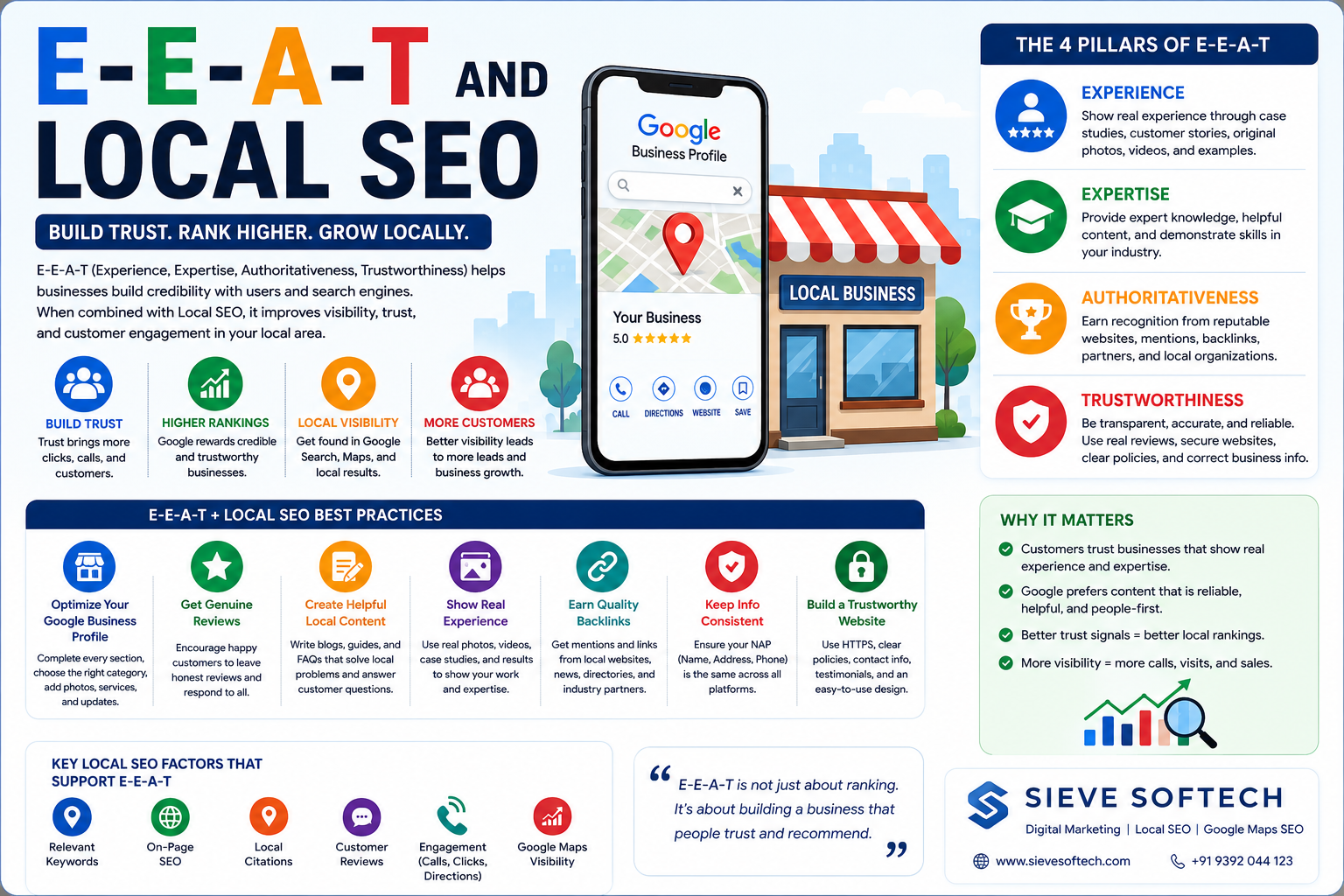
E-E-A-T and Local SEO: How to Build Trust and Improve Local Search Visibility in 2026
Introduction
Local SEO is no longer just about adding a city name to your website, creating a Google Business Profile, and collecting a few reviews. Customers want to know whether a local business is real, experienced, knowledgeable, trustworthy, and worth choosing.
This is where E-E-A-T becomes important.
E-E-A-T stands for:
- Experience
- Expertise
- Authoritativeness
- Trustworthiness
Google explains that E-E-A-T itself is not a single ranking factor. Instead, Google’s systems use a variety of signals to identify helpful and reliable content, and E-E-A-T is a useful framework for understanding what quality looks like. Google also says that trust is the most important part of E-E-A-T.
For local businesses, these principles can be especially useful because customers are often making decisions about where to spend money, who to hire, or which local service provider to trust.
In this guide, we’ll explain how E-E-A-T connects with Local SEO, how it can strengthen your online presence, and what businesses can do in 2026 to build greater credibility in Google Search and Google Maps.
What Is E-E-A-T?
E-E-A-T is Google’s framework for evaluating characteristics associated with high-quality content.
Experience
Experience shows that the content creator has first-hand knowledge or experience with the subject.
For example:
- A restaurant sharing original photos of its dishes
- A photographer showing real projects
- A digital marketing agency publishing results from an actual campaign
- A hotel describing facilities based on its own property
- A local business sharing customer case studies
First-hand experience can make content more useful and credible.
Expertise
Expertise refers to having appropriate knowledge or skill in a particular subject.
For example, a qualified accountant writing about taxation demonstrates professional expertise, while an experienced mechanic explaining vehicle maintenance demonstrates practical expertise.
Authoritativeness
Authority develops when a business or individual becomes recognized as a reliable source in their field.
This can come from:
- Industry recognition
- Strong content
- Mentions from reputable websites
- Professional credentials
- Relevant backlinks
- Community involvement
- Consistent expertise
Trustworthiness
Trust is the foundation of E-E-A-T.
Customers want to know:
- Who operates the business?
- Is the information accurate?
- Can I contact the business?
- Are reviews genuine?
- Is the website secure?
- Are prices and policies clear?
- Does the business actually provide the advertised service?
Google’s current guidance emphasizes trust as the most important aspect of E-E-A-T.
Why E-E-A-T Matters for Local SEO
Local SEO connects businesses with customers searching for nearby products and services.
For example:
“Best SEO agency near me”
“Dentist in Hyderabad”
“Courier service in Hyderabad”
“Best restaurant near Kukatpally”
In these searches, customers don’t simply want a keyword match. They want a business they can trust.
A strong Local SEO strategy therefore needs more than keywords.
It should demonstrate:
Experience + Expertise + Authority + Trust
Your Google Business Profile, website, reviews, social media presence, local citations, content, and customer experience can all contribute to the overall impression people get from your business.
Google says local results are designed to show businesses that are relevant to the search and that local ranking is primarily based on factors including relevance, distance, and prominence. E-E-A-T should therefore be viewed as a quality framework that supports a broader SEO strategy, rather than as a separate “ranking score.”
1. Experience: Show What Your Business Actually Does
Experience is particularly powerful for Local SEO because local businesses have something that generic websites often don’t: real-world experience.
Instead of publishing generic articles that could have been written by anyone, show customers what your business has actually done.
Examples
A digital marketing agency can publish:
- Client case studies
- Campaign results
- Website redesign examples
- SEO improvements
- Google Ads performance examples
A restaurant can publish:
- Original food photography
- Behind-the-scenes content
- Chef introductions
- Customer experiences
- New menu launches
A hair salon can show:
- Before-and-after results
- Hairstyle transformations
- Service demonstrations
- Staff expertise
- Real customer experiences
This type of content gives visitors evidence that the business actually does what it claims.
2. Expertise: Demonstrate Knowledge
Local businesses should create content that answers customer questions accurately.
For example, a digital marketing agency could publish:
“How Google Business Profile Categories Affect Local SEO”
A courier company could publish:
“Documents Required for International Courier Shipping from India”
A restaurant could publish:
“How to Choose Healthy Millet-Based Meals”
The content should be written or reviewed by someone who genuinely understands the subject.
Google’s guidance encourages creators to make it clear who created content and, where appropriate, provide author information and background that demonstrates relevant knowledge.
Add Author Information
Consider including:
- Author name
- Job title
- Professional background
- Relevant experience
- Author profile
- LinkedIn or professional profile where appropriate
This helps readers understand who is responsible for the information.
3. Authority: Become Known in Your Local Market
Authority doesn’t appear overnight.
It develops when other people consistently recognize and reference your business.
For Local SEO, authority can come from:
- Local publications
- Industry websites
- Business directories
- Professional associations
- Local partnerships
- Community organizations
- Relevant backlinks
- Media mentions
- Original research
For example, suppose a Hyderabad digital marketing agency is mentioned by several reputable local business websites and publishes useful Local SEO research.
Over time, these signals can strengthen its reputation.
However, don’t buy random backlinks simply to increase the number of links.
Focus on relevance and quality.
4. Trust: The Most Important Part of E-E-A-T
Trust is especially important for local businesses.
A customer may find your business through Google Maps but still visit your website before making a decision.
Your website should answer basic questions clearly.
Include:
- Business name
- Physical location or service area
- Phone number
- Email address
- Business hours
- Services
- Pricing information where appropriate
- About page
- Contact page
- Privacy policy
- Terms and conditions where relevant
If information is difficult to find, customers may hesitate to contact you.
5. Optimize Your Google Business Profile
Your Google Business Profile is one of the most important assets in Local SEO.
Keep it accurate and complete.
Make sure your profile includes:
- Correct business name
- Accurate category
- Address
- Phone number
- Website
- Business hours
- Services
- Products where applicable
- Photos
- Relevant attributes
Google recommends keeping Business Profile information complete and accurate because this helps customers understand what the business does, where it is located, and when it is available.
A complete profile also creates a better experience for customers discovering your business through Search and Maps.
6. Use Genuine Customer Reviews
Reviews are an important part of local reputation.
Customers often look at reviews before deciding whether to contact a business.
A strong review strategy should focus on genuine customer experiences.
Ask satisfied customers to leave honest feedback after completing a purchase or service.
Don’t:
- Buy reviews
- Create fake reviews
- Ask employees to post fake reviews
- Offer rewards in exchange for positive ratings
- Manipulate review content
Authenticity matters.
If you receive a negative review, respond professionally rather than becoming defensive.
A thoughtful response can demonstrate that your business listens to customers.
7. Create Location-Specific Content
One of the best ways to combine E-E-A-T with Local SEO is to create genuinely useful local content.
Instead of creating hundreds of nearly identical city pages, create content that has real value.
For example:
Weak approach
Best SEO Agency in Hyderabad
A generic page filled with keywords.
Better approach
How Hyderabad Businesses Can Improve Their Google Business Profile in 2026
This second topic provides a clear reason for someone to read the article.
It can include:
- Local search examples
- Hyderabad-specific customer behavior
- Industry examples
- Practical recommendations
- Original observations
- Local case studies
Google’s people-first guidance emphasizes creating content that provides substantial value rather than content produced primarily to attract search traffic.
8. Publish Real Case Studies
Case studies are one of the strongest ways to demonstrate Experience and Expertise.
A useful case study can explain:
The Problem
What challenge did the customer have?
The Strategy
What did your business do?
The Implementation
What steps were taken?
The Results
What changed?
For example:
Local SEO Case Study: Improving Google Maps Visibility for a Hyderabad Business
Include genuine information wherever possible.
You can show:
- Search visibility changes
- Website traffic
- Calls
- Leads
- Ranking improvements
- Review growth
Avoid making unsupported claims.
Real evidence is more powerful than exaggerated marketing language.
9. Add Original Photos and Videos
Original visual content is another way to demonstrate Experience.
Instead of using stock images for everything, show your real business.
Examples include:
- Office photos
- Team photos
- Storefront images
- Product images
- Service demonstrations
- Project photographs
- Behind-the-scenes videos
For a local business, these images can also help customers recognize the location before visiting.
10. Build Strong Local Citations
Local citations are mentions of your business information on other websites.
Common information includes:
- Business name
- Address
- Phone number
- Website
Relevant directories and industry listings can help establish consistency around your business identity.
However, don’t create hundreds of low-quality directory listings simply for the sake of quantity.
Prioritize:
- Relevant directories
- Industry associations
- Local business platforms
- Trusted local websites
Keep your information consistent.
11. Earn Relevant Local Backlinks
Backlinks can help establish authority when they come from relevant and trustworthy sources.
Potential opportunities include:
- Local news websites
- Industry publications
- Chamber of commerce websites
- Community organizations
- Local business partners
- Educational institutions
- Professional associations
For example, a local business participating in a community event could potentially earn a legitimate mention from the organization hosting the event.
The key is to earn relevant mentions rather than manipulate links.
12. Make Your Business Identity Clear
Customers should never have to guess who is behind your website.
Create a strong About Us page.
Include:
- Company background
- Founding story
- Team
- Experience
- Services
- Location
- Business values
- Professional credentials where relevant
For professional services, you can also create individual team profiles.
This is particularly useful when customers are choosing a person or specialist rather than simply a company.
13. Demonstrate Credentials Carefully
Credentials can strengthen expertise and trust when they are genuine and relevant.
Depending on your industry, these might include:
- Professional certifications
- Awards
- Licenses
- Memberships
- Training
- Educational qualifications
- Industry experience
Don’t exaggerate credentials.
If a certification is expired, misleading, or irrelevant, displaying it can damage trust instead of improving it.
14. Keep Content Accurate and Updated
E-E-A-T isn’t something you establish once.
Information changes.
Update content when:
- Services change
- Business hours change
- Regulations change
- Products change
- Pricing changes
- Google features change
- Industry information becomes outdated
But don’t change publication dates simply to make old content appear fresh. Google’s people-first guidance specifically warns against changing dates without substantially updating the content.
15. AI Content and E-E-A-T
AI tools can help businesses with research, brainstorming, editing, and content workflows.
However, AI should not replace real expertise and first-hand information.
Google’s guidance focuses on the quality and purpose of content rather than whether AI was used to produce it. Google says content should be created primarily to help people, and using automation to produce content primarily to manipulate search rankings can violate its spam policies.
For Local SEO, this is particularly important.
Don’t publish dozens of generic AI-generated pages such as:
- Best SEO agency in Hyderabad
- Best SEO agency in Vijayawada
- Best SEO agency in Guntur
- Best SEO agency in Vizag
if every page says essentially the same thing.
Instead, add genuine local information and experience.
16. Improve Your Website’s Technical Foundation
E-E-A-T doesn’t replace technical SEO.
Your website still needs to be accessible and usable.
Check:
- Mobile usability
- Page speed
- HTTPS
- Crawlability
- Indexability
- Broken links
- Structured navigation
- Clear internal linking
- Readable content
Google’s Search Essentials identify technical requirements, spam policies, and key best practices that help pages become eligible to appear in Search.
A trustworthy business with a difficult-to-use website can still lose potential customers.
17. Use Local Business Schema Carefully
Structured data can help search engines understand information about your business.
Depending on your business, relevant structured data may describe:
- Organization
- Local business
- Address
- Opening hours
- Contact information
- Services
Structured data isn’t a shortcut to better rankings, but it can help search engines understand your page and business information.
Make sure any structured data accurately reflects visible information on your website.
18. Create a Consistent Local SEO Ecosystem
Your online information should tell the same story everywhere.
For example:
Google Business Profile:
Sieve Softech – Digital Marketing Agency
Website:
Sieve Softech – Digital Marketing & SEO Services
Local directory:
Sieve Softech – Digital Marketing Agency
Social profiles:
Consistent business information
Consistency helps customers and search engines understand your business.
E-E-A-T Local SEO Checklist for 2026
Use this checklist to evaluate your business.
Experience
- Original photos
- Real case studies
- First-hand insights
- Customer examples
- Demonstrations and videos
Expertise
- Expert-written content
- Author information
- Professional credentials
- Detailed service pages
- Helpful FAQs
Authority
- Relevant backlinks
- Local media mentions
- Industry mentions
- Professional associations
- Community involvement
Trust
- Accurate business information
- Genuine reviews
- Professional review responses
- Clear contact details
- Secure website
- Transparent policies
- Accurate claims
How Sieve Softech Can Help With E-E-A-T and Local SEO
Building E-E-A-T requires more than publishing blog posts. Businesses need a complete digital presence that demonstrates real experience, expertise, authority, and trust.
Sieve Softech can help businesses strengthen their Local SEO strategy through:
- Google Business Profile Optimization
- Google Maps SEO
- Local SEO
- Keyword Research
- Local Citation Management
- Reputation Management
- Review Management
- Content Marketing
- Technical SEO
- Website Optimization
- Local Content Strategy
- Google Ads
- Social Media Marketing
- SEO Reporting
Our approach focuses on creating useful content, improving local visibility, strengthening business credibility, and building a consistent online presence.
For businesses competing in local search, the objective isn’t simply to rank for more keywords. It’s to become a business that customers and search engines can understand and trust.
Frequently Asked Questions
Is E-E-A-T a Google ranking factor?
Google says E-E-A-T itself is not a specific ranking factor. Instead, Google’s systems use many signals to identify content that demonstrates qualities associated with E-E-A-T.
What does E-E-A-T mean in Local SEO?
It means demonstrating real-world experience, subject expertise, authority in your market, and trustworthiness across your website, Google Business Profile, reviews, content, and broader online presence.
Are reviews part of E-E-A-T?
Reviews are an important trust and reputation signal for local businesses, although E-E-A-T should not be reduced to one specific factor. Genuine customer experiences can help potential customers evaluate a business.
Does AI-generated content hurt E-E-A-T?
Not automatically. Google’s guidance focuses on whether content is helpful, reliable, original, and created for people. AI-generated content created primarily to manipulate rankings can violate Google’s spam policies.
How can a small local business demonstrate E-E-A-T?
Start with simple things: show real work, publish useful expert content, identify authors, collect genuine reviews, maintain accurate business information, create original photos, explain your services clearly, and build relationships with relevant local organizations.
Conclusion
E-E-A-T and Local SEO work well together because both ultimately come back to one important question:
Can customers trust this business?
A strong local presence isn’t built through keywords alone. Customers want evidence that your business is genuine, experienced, knowledgeable, and reliable.
Show real work. Publish useful information. Make your authors and experts visible. Keep your Google Business Profile accurate. Encourage genuine reviews. Earn relevant local mentions. Maintain a trustworthy website. And update your content when information genuinely changes.
Google’s current guidance strongly emphasizes helpful, reliable, people-first content, with experience, expertise, authoritativeness, and trustworthiness serving as useful ways to evaluate quality.
For Local SEO in 2026, businesses that focus on real experience, useful information, genuine reputation, and customer trust will be better positioned to build sustainable visibility across Google Search and local search experiences.
If you want to strengthen your Google Business Profile, Google Maps visibility, reputation, and Local SEO strategy, Sieve Softech can help you build a practical strategy around your business, location, services, and target customers.